Helius
Ἥλιος |
|
|
|
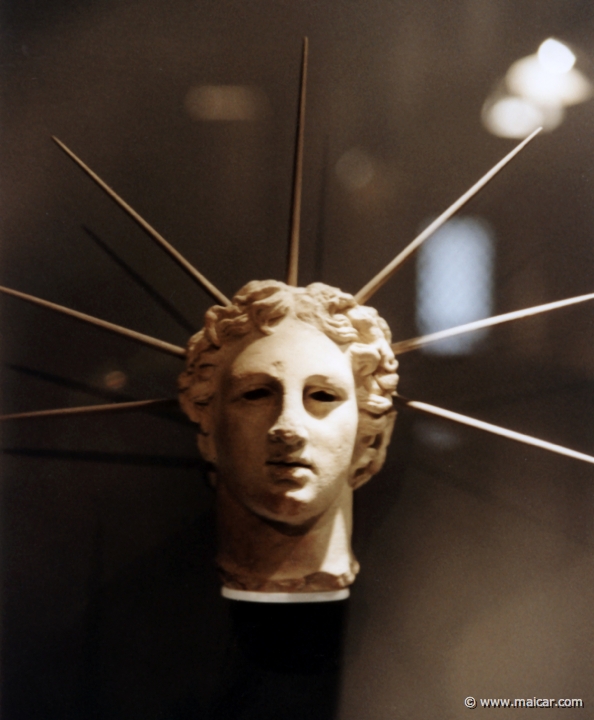
Helius. 2018: Ancient head in Rhodes.
|
|
|
|
Helius, whose palace (made by Hephaestus) stands on columns of gold and bronze, and has gables of ivory, is the Sun. That is why it is said that his eye is everywhere, and that his portion is labor every day. Over the waves, in a winged and hollow bed forged of gold by Hephaestus, Helius is
carried in sleep from the Hesperians' country to
the land of the Ethiopians, where his horses and
chariot stand till Eos (Dawn) appears, and then Helius mounts his car.
There is no rest for Helius and his horses when Eos has left the ocean and climbed the sky. (The names of the horses of Helius can be found at BESTIARY).
|
|
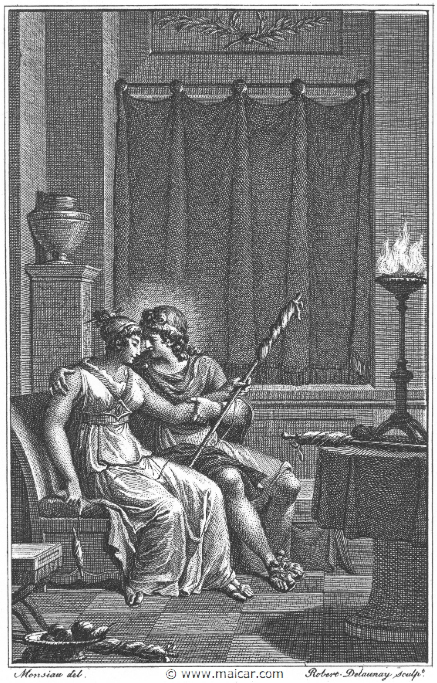
Helius interrupts Leucothoe 2's spinning and seduces her.
Drawing by Nicolas-André Monsiau, 1754-1837 (Les Métamorphoses d'Ovide, Paris 1806).
|
|
|
|
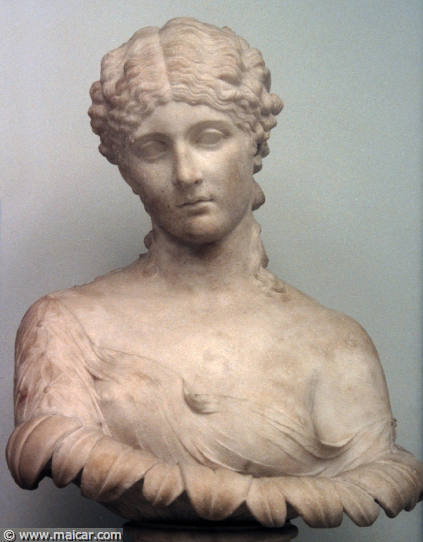
Clytia 3. Her love was scorned by the god, and she destroyed his new mistress.
8001: Clytie. Parian marble, AD 40-50. British Museum, London.
|
|
Helius and Corinth
The Corinthians tell that Poseidon had a dispute
with Helius about the land about Corinth, and that
Briareus, one of the HECATONCHEIRES ,
arbitrated between them, assigning the Isthmus to Poseidon, and the
height above the city to Helius. They add that
Helius later handed over the Acrocorinthus to Aphrodite; but the
land of Corinth is also
said to have been given by Helius to Aeetes before the latter
emigrated, becoming king of Colchis.
Reveals secrets
His eye being everywhere, Helius is said to have
been the one who reported to Hephaestus about the
love affair between Ares and Aphrodite. And he
also reported to Demeter what had happened to her daughter Persephone when Hades abducted her.
His love for a girl causes her death
But for having revealed to Hephaestus her love
for Ares, Aphrodite made Helius to fall in love with Leucothoe 2, daughter of Orchamus, king over the cities of Persia and the seventh in line from Belus 2. Assuming the shape of the girl's mother Eurynome 5, Helius came to her home, and after dismissing the slaves who were in the room, and interrupting her work with the spindle, he made love to her. However, Clytia 3, a former love of the god who was still in love with Helius but was scorned by him, burning with jealousy and wrath, spread the story everywhere, and informed King Orchamus about it. The king then, being ignorant of the nature of love, let his own daughter be buried alive. Indeed, using power to spread death was for him a good thing, but love he considered a shame. However, Clytia 3 could not get Helius and she went mad.
For whole days she tasted neither food nos drink
and stood on the same spot on the groud, turning
her face towards the sun. Finally, her face turned
into a flower much like a violet, and herself into
a plant.
Not always mild
Gods do not suffer mortals comparing themselves with them. And Helius, who otherwise is quite mild, disliked it just as other gods do. So when Arge, a huntress who was pursuing a stag said that she would catch it even if it equalled the speed of Helius, the god, for this boast, turned her into a doe. And when Odysseus' crew slaughtered his cattle in Thrinacia, he threatened to shine among the dead instead of shining among the immortals and the living mortals (full story at Charybdis).
|
|
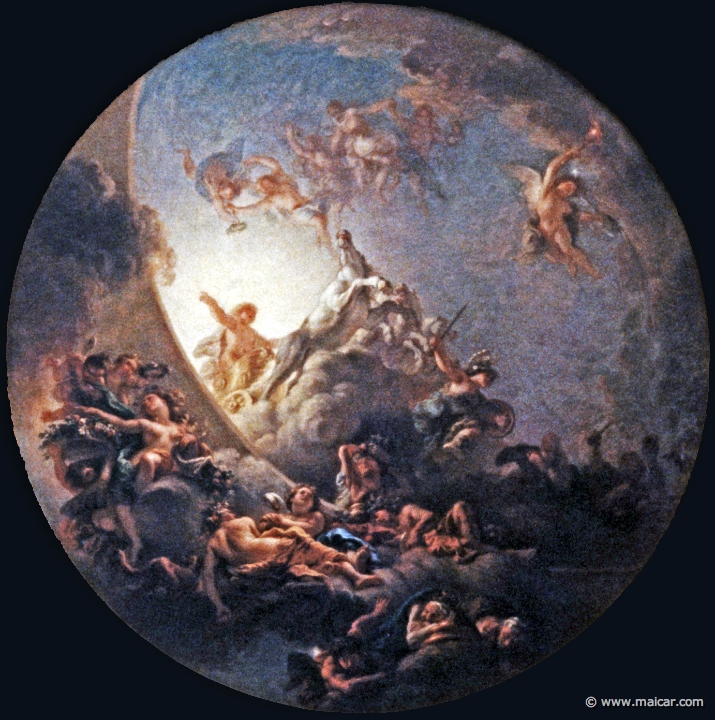
Helius awakens the gods. 4425: Charles de la Fosse 1636-1716: Le lever du soleil. Musée des beaux arts, Rouen.
|
|
|
| Family |
|
|
|
|
|
|
|
|
|
"a)", "b)", etc. = different versions.
For Augeas see Heracles 1.
|
|
|
|
Aegle 1 is daughter of Atlas and Hesperis, that
is, one of the HESPERIDES, who
guarded the Golden Apples that Heracles 1 had to
fetch. Some call her, however, a daughter of Nyx.
|
|
|
|
Aex is one of the nurses of Zeus, said to have a
beautiful body but a most horrible face
|
|
|
|
Perseis is one of the OCEANIDS.
|
|
|
Circe was a witch who
lived in the island of uncertain location called
Aeaea. She purified the ARGONAUTS for the
murder of Apsyrtus, and received Odysseus and his
comrades. To these comrades she gave a potion, and
when they had drunk it off, she smote them with her
wand, and put them in the sties transformed into
pigs.
|
|

a) Pasiphae
|
Pasiphae was queen of Crete. She bewitched her
husband Minos 2 so that whenever he took a lover he made wild beasts attack her, and so the women perished. Pasiphae is also known for the wooden cow (see also Daedalus).
|
|
|
b) Pasiphae
|
|
|
|
|
|
|
|
|
Clymene 1 is one of the OCEANIDS.
Phaethon 3 asked
for his father's chariot and the right to drive it
for a day, but being an unexperienced driver, he
set the heavens afire. Consequently, Zeus killed him with a
thunderbolt, and sent him rolling from on high into
the river Eridanus. Some affirm that Phaethon 3 asked for
permission to drive the chariot, but others say
that he mounted it secretly. It is also told that
he fell into the river Eridanus (according to some
the river Po in Italy) because he had been borne
too high above the earth and he felt fear. Now,
when Zeus struck him,
everything on earth started to burn; and Zeus, who hoped for a
chance to destroy all mortals, pretending that he
wanted to put out the fire sent the Flood that killed almost
everyone except Deucalion 1 and his wife. So they tell, and some also add
that when everything burned, the Indians became
black because their blood darkened from the heat.
|
|
|
The HELIADES 1 wept so much for their brother Phaethon 3 that their tears hardened into amber and they were turned into poplars. But it is also said that the HELIADES 1 were transformed into poplars for having yoked the horses without the instructions of their father. The HELIADES 1 are: Aegle 2, Aetheria, Astris, Dioxippe 2, Helie, Lampetia, Merope 5, Phaethusa, and Phoebe 4. Of these Phaethusa was the youngest. It has been told that Astris married the river god Hydaspes 1 and had by him a son Deriades, who became King of India.
|
|
|
|
The HELIADES 2, sons of Helius by Rhode 2, daughter of Poseidon,
were astrologers, introduced new practices in
seamanship, and divided the day into hours. The
most highly endowed of them was Tenages, who was
slain by his brothers because of their envy of him.
When their treacherous act became known, all who
had had a hand in the murder took to flight and
settled in different places.
The HELIADES 2 are Actis, Auges, Candalus, Cercaphus 1, Electryone, Macar 1, Ochimus, Tenages, Thrinax, Triopas 2.
|
|
|
|
Actis
|
Actis Sailed off to Egypt and founded there the city of Heliopolis (Dio.5.56.3-5).
|
|
Auges
|
Along with his brothers Auges drove the
TELCHINES out of Rhodes (Dio.5.56.3-5; Nonn.14.44).
|
|
Candalus
|
Candalus settled in Cos, one of the Sporades Islands (now Dodecanese) off the southwestern coast of Asia Minor (Dio.5.56.3-5).
|
|
Cercaphus 1
|
Cercaphus 1 succeeded to the throne of Rhodes after his brother Ochimus. He married Cyrbia, daughter of Ochimus, and had sons (Camirus, Lindus, and Ialysus) who succeeded him upon his death (Dio.5.56.3-5, 5.57.7).
|
|
Electryone
|
The only female among the HELIADES 2 (Dio.5.56.3-5).
|
|
Macar 1
|
King of Lesbos, sometimes called son of
Crinacus (son of Zeus). Macar 1 had children: Methymna, Mytilene, and Cydrolaus (DH.1.18.1; Dio.5.56.3-5, 5.81.4-8; Hom.Il.24.544).
|
|
Ochimus
|
The oldest of the HELIADES 2 and their king. Ochimus married Hegetoria, one of the NYMPHS, and fathered Cyrbia (Dio.5.56.3-5, 5.57.7).
|
|
Tenages
|
For being the most gifted of the HELIADES 2, Tenages caused envy among his brothers and was killed by them (Dio.5.56.3-5).
|
|
Thrinax
|
Along with his brothers Thrinax drove
the TELCHINES out of Rhodes (Dio.5.56.3-5; Nonn.14.44).
|
|
Triopas 2
|
Because of the murder of his brother Tenages, Triopas 2, son of Helius, sailed first from Rhodes to the
Chersonesus, which lies on the mainland
opposite the island, and later emigrated
to Thessaly where he assisted the sons of Deucalion 1 to expel the Pelasgians. He then became
king of the Thessalians and in trying to
roof his own house, tore down the temple
of Demeter,
built by the men of old. For this reason
he incurred the hatred of the Thessalians
and fled to Chersonesus and Caria (in
southwestern Asia Minor) where he founded
Triopium in the territory of Cnidus. It is
also said that when hunger was brought on
him for having destroyed the temple of Demeter, he
could never afterwards be satisfied by any
amount of food. Towards the end of his
life, when a snake was sent to plague him,
he suffered many ills; but when he died,
he was put among the stars by the will of Demeter (see also Erysichthon 2). Some say that Triopas 2 was son of Poseidon and Canace; others say that he was son of Lapithus 1. Triopas 2 had children by Hiscilla (daughter of Myrmidon): Phorbas 2, Erysichthon 2, and Iphimedia—see also CONSTELLATIONS (Apd.1.7.4; Cal.Dem.65ff, 97; Dio.5.56.3ff, 5.61.1ff.; Hom.Apo.211; Hyg.Ast.2.14; Ov.Met.8.738ff.; Pau.10.11.1).
|
|
|
|
|
Aloeus 2 was king of Asopia (Sicyon) and father of Epopeus 1.
|
|
|
|
The HORAE are the
Wardens of the sky and of Olympus. Their task is to
open and close the Gates of Heaven. They were
handmaids of Helius and were given the ordering and
adornment of life. When believed to be daughters of
Helius (there are other versions of their
parentage), they are considered as Seasons rather
than Hours.
|
|
|
|
Ceto 3 is a naiad. Astris was mother, by the river god Hydaspes 1, of the Indian King Deriades, who was killed by Dionysus 2 and the MAENADS.
|
|
|
|
|
|

Clytia 3
|
|
Clytia 3 had been loved by Helius, but when the god fell in love with Leucothoe 2, he forgot about her. Clytia 3 took revenge against Leucothoe 2 letting the latter's father Orchamus know about his daughter's amorous adventures with the god. Orchamus killed his own daughter, but Clytia 3 could not get the god's love again. Consequently, she went mad. She tasted neither food nos drink, and stood on the same spot on the groud, turning her face towards the sun. Finally, her face turned into a flower much like a violet, and herself into a plant
|
|
|
|
|
|
|
|
|
|
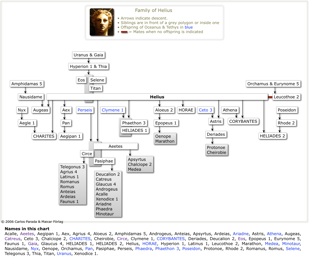
|
Genealogical Charts
Names in this chart: Acalle, Aeetes, Aegipan 1, Aex, Agrius 4, Aloeus 2, Amphidamas 5, Androgeus, Anteias, Apsyrtus, Ardeias, Ariadne, Astris, Athena, Augeas, Catreus, Ceto 3, Chalciope 2, CHARITES, Cheirobie, Circe, Clymene 1, CORYBANTES, Deriades, Deucalion 2, Eos, Epopeus 1, Eurynome 5, Faunus 1, Gaia, Glaucus 4, HELIADES 1, HELIADES 2, Helius, HORAE, Hyperion 1, Latinus 1, Leucothoe 2, Marathon, Medea, Minotaur, Nausidame, Nyx, Oenope, Orchamus, Pan, Pasiphae, Perseis, Phaedra, Phaethon 3, Poseidon, Protonoe, Rhode 2, Romanus, Romus, Selene, Telegonus 3, Thia, Titan, Uranus, Xenodice 1.
|
|
|
| Related sections |
|
|
|
Sources
Abbreviations |
AO.1216;
Apd.1.2.2, 1.9.1; Dio.4.60.4, 5.56.3-5; Hes.The.371, 1011;
Hom.Dem.2.26; Hyg.Ast.2.13;
Hyg.Fab.14, 154; Mimn.8; Nonn.12.1, 8.347 26.355;
Ov.Met.1.751ff; Pau.2.1.1, 9.35.5; Soph.OC.869;
Strab.10.3.19.
|
|
|


