 |
|
|
|
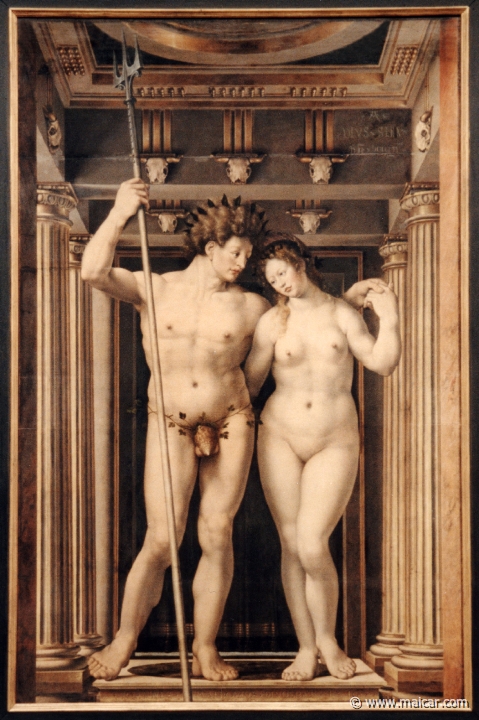
2319: Poseidon and Amphitrite. Painting by Jan Gossaert, 1478-1532. Gemälde Galerie Kulturforum, Berlin.
|
|
Poseidon, the earth-shaker, was alotted the
dominion of the sea (just as Zeus got the sky, and Hades the Underworld); and he
received the trident from the CYCLOPES (just as Zeus got the thunderbolt,
and Hades a helmet).
Poseidon was the first to concern himself with
seafaring, and the first to tame horses.
Birth and childhood
The Arcadians say that when Poseidon was born
his mother declared to her husband Cronos, who used to
swallow his offspring at birth, that she had given
birth to a horse, and so she presented him a foal
to swallow instead of the child, just as later she
offered him a wrapped stone in place of Zeus. Rhea 1 committed the child
Poseidon to Caphira (one of the OCEANIDS) and to the TELCHINES (see CORYBANTES), so that they would nurture him, much in the way as she later committed Zeus to the
CURETES for his protection. But others say that
Poseidon was swallowed by his father, as also were
his siblings Hestia, Hera, Hades and Demeter; for they assert
that only Zeus escaped that
fate.
Lord of the sea
When Zeus had grown up, he asked Metis 1 to help him against his father Cronos, who was a stern
tyrant; so she gave Cronos a drug, which
forced him to disgorge first the stone with which Rhea 1 had deluded him,
and then the children whom he had swallowed, among
which Poseidon. And with the aid of his brothers
and sisters Zeus waged war
against Cronos and the TITANS, whom he defeated
and cast into Tartarus, a place as far beneath the
earth as heaven is above earth. Having won victory,
they cast lots for the sovereignty, and to Zeus was allotted the
dominion of the sky, to Poseidon the dominion of
the sea, and to Hades the
dominion of the Underworld. Then
Poseidon constructed the brazen fence that runs
round Tartarus and its gates of bronze, behind
which the TITANS were confined (for Tartarus see also Underworld).
Plots against Zeus
Poseidon took once part in a minor conspiracy in
heaven; for he, along with Hera and Athena, had agreed to put Zeus in bonds. However, he
was saved by Briareus (one of the HECATONCHEIRES),
whom Achilles' mother
Thetis had called to Zeus'
rescue; and by just squatting down close to him and
through the mere display of his force, Briareus
frightened Poseidon and the goddesses away.
Dispute with Helius
According to the Corinthians, this same Briareus
acted as adjudicator arbitrating between Helius and Poseidon, who
had a dispute concerning the lands about Corinth. He then
assigned to Poseidon the Isthmus of Corinth including the adjacent lands, and gave to Helius the height above
the city (Acrocorinthus).
Dispute with Hera
A similar dispute, though this time for the
patronage of Argos,
involved Poseidon and Hera.
A tribunal of three RIVER
GODS: Inachus, Cephisus, and Asterion 2, decided on this occasion that Argolis would belong to Hera and
not to Poseidon. Disappointed with this judgement,
the god made their waters disappear, and that is
why they never provide any water except after rain,
their streams being dry during the summer. But
since little and much must compensate each other,
Poseidon inundated many districts in Argolis because of the decisions of the RIVER GODS. Lerna is however, excepted; for it was here that Amymone 1 (one of the DANAIDS) yielded to
Poseidon on condition that she might have water,
and the god, being in love with her, revealed to
her the springs at Lerna.
Dispute with Athena (I)
Yet another disagreement concerning the
patronage of lands and cities arised between
Poseidon and Athena in
relation to Troezen. But Zeus commanded them to hold this city in common, and so they did. This dispute took place during the reign of King Althepus, himself son of Poseidon and Leis, the daughter of Orus 1, predecessor of Althepus.
|
|
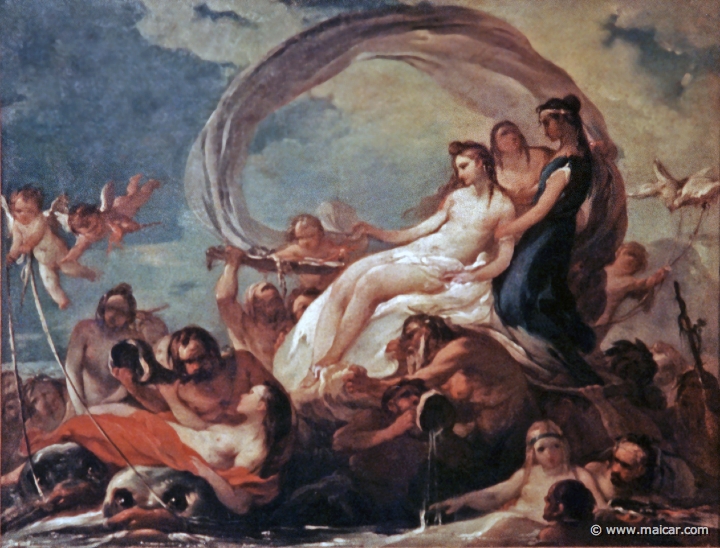
Amphitrite. 4611: Joseph-Marie Vien 1716-1809: Triomphe d'Amphitrite. Musée des beaux arts, Caen.
|
|
Dispute with Athena (II)
Poseidon, they say, was the first who came to
Attica; and with a blow of his trident on the
Acropolis, he produced a sea or, as some say, just
a well of sea-water that could be seen in the
Erechtheum on the Acropolis not far from the
outline of the trident on the rock. These were the
evidences in support of Poseidon's claim to the
land. But Athena, coming
after him, planted an olive tree and claimed the
land; and since they fought for the possession of
the country, Zeus parted
them and appointed the OLYMPIANS as arbiters,
who adjudged the city to Athena, because King Cecrops 1 witnessed that she had been the first to plant the olive tree. Athena called the city Athens after herself, but
Poseidon, angry at the verdict flooded Attica.
However, some say that it was Zeus who ajudged Athens to Athena, and that Poseidon
never flooded the country because Hermes forbade him to do
so. In any case, in the shrine of Erechtheus there
remained preserved a long time an olive tree and a
pool of salt water which had been set there by Athena and Poseidon as
tokens when they contended for the city.
Thetis
Zeus and Poseidon were
once rivals for the hand of Thetis, but when Themis, or the MOERAE, or Proteus 2 prophesied
that the son born of Thetis would be mightier than
his father, they withdrew. Zeus then, bade his
grandson Peleus to marry
her, and from their union Achilles was born, who
was mightier than his father.
Marriage
It is said that when Poseidon decided to marry
the Oceanid Amphitrite, she, wishing to remain a
virgin, escaped and fled to Atlas. Poseidon then send
many to look for her, and among them a certain
Delphin, who after long wanderings, found her and
persuaded her to marry Poseidon, organizing himself
the whole wedding. For this reason, they say,
Poseidon put the dolphin among the CONSTELLATIONS.
The walls of Troy
When Laomedon 1 was king of Troy, Apollo and Poseidon decided to put him to the test, and assuming the likeness of mortal men, fortified the city for wages. But when the work was done, King Laomedon 1 would not pay their wages; so Apollo sent a pestilence, and Poseidon sent a sea-monster that snatched away the people of the plain. Since oracles foretold deliverance from these calamities if Laomedon 1 would expose Hesione 2 to be devoured by the sea-monster, he exposed her
by fastening her to the rocks near the sea, but Heracles 1 delivered
her.
More monsters
On another occasion, Poseidon sent another sea-monster against the Teucrians because Hierax 2, otherwise a righteous man, was devoted to Demeter, and would not honour him. Poseidon also shared the wrath of the NEREIDS, when Queen Cassiopea 2 boasted of being better than them; and he sent a flood and yet another sea-monster to invade the land. The seer Ammon 3 predicted deliverance from the calamity if the queen's daughter Andromeda were exposed as a prey to the monster. So her father King Cepheus 1 was then compelled by the Ethiopians to do it, and he bound Andromeda to a rock.
But the girl was rescued by Perseus 1, who slaughtered the beast. Poseidon heard his son Theseus when he,
believing Phaedra's charges against Hippolytus 4, prayed to the god that Hippolytus 4 might perish. And when this young man was riding in his chariot and driving beside the sea, Poseidon sent up a bull from the waves, and the horses were frightened, the chariot dashed to pieces, and Hippolytus 4, entangled in the reins, was dragged to death.
Atlantis
In the legend of Atlantis, which is not
connected to other myths except for the names of Atlas and Poseidon, the
first ten kings of Atlantis (five pairs of twins) were all sons of Poseidon and Cleito 2. The first born was Atlas, who was appointed to be king over the rest, and the island was called after him.
|
Mates & Offspring
"a)", "b)", etc. indicate different versions; "---" means unknown |
|
|
|
|
|
Arethusa 1
|
Abas 1
|
Arethusa 1 is one of the NEREIDS. Abas 1 was king in the island of Euboea, where the inhabitants were called Abantians after him. He was father of Canethus 1 and, some say, of Canthus 1. Canethus 1 is counted among the ARGONAUTS.
|
|
Larisa 1
|
Achaeus 2
|
Larisa 1 is daughter of Pelasgus 2, son of Triopas 1, son of Phorbas 1, son of Argus 5, son of Zeus and Niobe 1, the daughter of Phoroneus, the first man. Achaeus 2 is the eponym of the district called Achaea.
|
|
Arne
|
Aeolus 3
|
This Aeolus is said to have come in possession
of the islands in the Tyrrhenian Sea which are
called Aeolian after him.
|
|
Alcyone 1
|
Aethusa
|
Alcyone 1 is one of the PLEIADES.
|
|
Nymph 10
|
Agelus
|
|
|
Libya
|
Agenor 1
|
Agenor 1, who sometimes is called son of Belus 1 & Anchinoe, was born in Egypt but departed to Phoenicia and reigned there. He had children either by Telephassa, or by Argiope 2: Europa, Cadmus, Phoenix 1, Cilix, Thasus, and Phineus 2.
|
|
Canace
|
Aloeus 1
|
Aloeus 1 is the founder of Alus, a city of Aetolia.
|
|
Leis
|
Althepus
|
Althepus was king of Troezen.
|
|
---
|
Amphimarus
|
Amphimarus is said to be the father of Linus 1, a great musician.
|
|
Melie
|
Amycus 1
|
Melie was a Bithynian Nymph. Amycus 1 was king of the Bebrycians, who received the ARGONAUTS.
|
|
a) Althaea
|
Ancaeus 2
|
For Althaea see MOERAE. Ancaeus 2, king of Samos, is one of the ARGONAUTS.
|
|
b) Astypalea
|
|
|
---
|
Antaeus 1
|
See Heracles 1.
|
|
Alcyone 1
|
Anthas
|
Anthas founded Anthea or Anthedon (now Poros).
Later he emigrated and founded Halicarnassus.
|
|

Demeter
|
Arion 1
|
Arion 1 was a horse.
|
|
a) Pero 1
|
Asopus
|
Asopus is a River God. He made his home in
Phlius, but in search of his daughter Aegina, who
had been carried off, he came to Corinth and learned from Sisyphus that the
ravisher was Zeus. Asopus
pursued him, but Zeus, by
hurling thunderbolts, sent him away to his own
streams.
|
|
b) Celusa
|
|
|
Mideia
|
Aspledon
|
Aspledon gave his name to Aspledon, near
Boeotian Orchomenus.
|
|
Tritonis
|

Athena
|
The Lake Tritonis in Libya. According to the
Libyans Athena was the
daughter of Poseidon and Lake Tritonis.
|
|
Cleito 2
|
The kings of Atlantis
|
|
|
---
|
Augeas
|
See Heracles 1.
|
|
Libya
|
Belus 1
|
King of Egypt.
|
|

Amphitrite
|
Benthesicyme
|
Benthesicyme had two daughters by an Ethiopian
husband.
|
|
a) Arne
|
Boeotus
|
After Boeotus the Boeotians are called
|
|
b) Antiope 5
|
|
|
a) Lysianassa 2
|
Busiris 2
|
See Heracles 1.
|
|
b) Anippe
|
|
|
Celaeno 1
|
Celaenus 2
|
Celaeno 1 is one of the DANAIDS.
|
|
Pirene 2
|
Cenchrias
|
Cenchrias gave his name to the Corinthian harbor of Cenchrae. When he died Pirene 2 shed so many tears that she became a spring.
|
|
Nymph 9 Chian
|
Chios
|
|
|

Medusa 1
|
Chrysaor
|
Chrysaor was King of Iberia.
|
|
Chrysogenia
|
Chryses 1
|
Chryses 1 succeeded Phlegyas 1 as king of the Phlegyans. Father of Minyas.
|
|
---
|
Corynetes
|
A bandit. He carried a club and with it killed
anyone who passed by. Was killed by Theseus.
|
|
---
|
Cromus 2
|
|
|
Molione
|
Cteatus
|
One of the MOLIONIDES. General of the Eleans
against Heracles 1.
|
|
Salamis
|
Cychreus
|
Cychreus became king of Salamis through killing
a snake which ravaged the island and bequeathed the
kingdom to Telamon, father of Ajax 1. The island is
called after his mother.
|
|
Calyce 2
|
Cycnus 1
|
King in Colonae, a city in the Troad.
|
|
---
|
Cymopolea
|
Poseidon gave this daughter to Briareus on
account of his braveness in the war against the TITANS.
|
|
---
|
Dercynus
|
This Dercynus attempted, in Liguria, to rob Heracles 1 of the
cattle of Geryon.
|
|
Demeter
|
Despoina
|
The real name of this mistress not to be
divulged to the uninitiated.
|
|
Agamede
|
Dictys 4
|
Agamede was the eldest of Augeas' daughters.
|
|
Eurycyda
|
Eleius 1
|
Eurycyda is daughter of Endymion. Eleius 1 is the eponym of the Eleans, who live in Elis.
|
|
Melantheia
|
Eirene 2
|
|
|
Iphimedia
|
Ephialtes 2
|
Poseidon consorted with Iphimedia, taking the
form of the river Enipeus. For the child see ALOADS
in Zeus.
|
|
Canace
|
Epopeus 1
|
Epopeus 1 was an immigrant from Thessaly. He became king of Sicyon.
|
|
---
|
Erginus 2
|
One of the ARGONAUTS.
|
|
---
|
Eryx 1
|
King over the Elymi in Italy, who challenged Heracles 1 to wrestle
for the sake of a bull.
|
|
Chione 1
|
Eumolpus 1
|
Eumolpus 1 was thrown into the sea by his mother and brought up by Benthesicyme. Cleansed Heracles 1 of the
slaughter of the CENTAURS and initiated
him at Eleusis. Fought
on the side of the Eleusinians in their war against
the Athenians and was killed by Erechtheus.
|
|
a) Europe 2
|
Euphemus 1
|
Mecionice was native of Hyria. Euphemus 1 came from Psamathe to join the ARGONAUTS. Received a
magical clod from Triton and threw it into the sea,
following a dream, and therefrom rose an island,
Calliste, where his descendants, led by Theras,
came.
|
|
b) Mecionice
|
|
|
Celaeno 2
|
Euphemus 4
|
Celaeno 2 is one of the PLEIADES.
|
|
Astypalea
|
Eurypylus 4
|
Eurypylus 4 was king of Cos.
|
|
Molione
|
Eurytus 1
|
One of the MOLIONIDES. General of the Eleans
against Heracles 1.
|
|
---
|
Eusiros
|
|
|
Pitana
|
Evadne 3
|
Evadne 3 consorted with Apollo and became the
ancestor of a family of seers.
|
|
Euryte 1
|
Halirrhothius
|
|
|
Antiope 5
|
Hellen 2
|
|
|
Alope
|
Hippothous 2
|
Poseidon transformed Alope into a spring that was called after her. Hippothous 2 was exposed by her mother but was suckled by a mare. He became one of the CALYDONIAN
HUNTERS.
|
|
Canace
|
Hopleus 1
|
|
|
Alcyone 1
|
Hyperenor 1
|
Hyperenor 1 is the founder of Hyperea.
|
|
Alcyone 1
|
Hyrieus
|
Hyrieus owned a treasure inside a building built by Trophonius and Agamedes 1, which had a stone that they could take away from the outside, thus robbing him, until one of them was caught in a trap made by Hyrieus.
|
|
---
|
Ialebion
|
Attempted, in Liguria, to rob Heracles 1 of the kine
of Geryon but was killed by him.
|
|
Arene
|
Idas 2
|
The city Arene in Messenia is named after her. Idas 2 is one of the ARGONAUTS and one of
the CALYDONIAN
HUNTERS. He killed Castor 1, one of the DIOSCURI.
|
|
---
|
Laestrygon
|
From him sprang the people of the isle of
Ortygia
|
|
---
|
Lamia 1
|
Lamia 1 was seduced by Zeus and Sibyl was born.
Sibyl is a surname, but this is the first woman who
chanted the oracles at Delphi.
|
|
Pirene 2
|
Leches
|
Leches gave his name to the Corinthian harbor of Lechaeum.
|
|
Libya
|
Lelex 2
|
Lelex 2 came from Egyp to Laconia and there he became king.
|
|
Themisto 2
|
Leuconoe 2
|
|
|
Celaeno 2
|
Lycus 2
|
Poseidon made Lycus 2 dwell in the Islands of the Blest.
|
|
---
|
Lycus 6
|
A descendant of Lycus 5 from Dirphys in Euboea, who killed Creon 2 and
seized power in Thebes.
Killed by Heracles 1.
|
|
Oenope
|
Megareus 2
|
Came from Onchestus with an army of Boeotians to help Nisus 1 in his war against Minos 2, but was killed
in battle. The city of Megara was named after
him.
|
|
---
|
Melas 4
|
|
|
---
|
Messapus
|
Messapus fought against Aeneas in Italy as an
ally of Turnus.
|
|
---
|
Minyas
|
Owned a marvellous treasure in Orchomenus. The Minyans are called after
him.
|
|
Melie
|
Mygdon
|
Melie was a Bithynian Nymph. Mygdon was the king
of the Bebrycians who once fought with Priam 1 against the AMAZONS.
|
|
Amymone 1
|
Nauplius 1
|
Amymone 1 was one of the DANAIDS (see text above). Nauplius 1 lived to a great age and to avenge the death of his son contrived for the wives of the Greeks fighting at Troy to play their husbands false (see Agamemnon).
|
|
Periboea 1
|
Nausithous 1
|
Nausithous 1 was king of the Phaeacians (Corcyra).
|
|
Tyro
|
Neleus
|
Neleus was exposed as
a child. When he and his twin brother were grown up
they killed their stepmother Sidero. Having been
banished he came to Messenia and founded Pylos.
|
|
Canace
|
Nireus 1
|
|
|
Celaeno 2
|
Nycteus 1
|
Nycteus 1 is sometimes said to be the father of Callisto.
|
|
Ascra
|
Oeoclus
|
Oeoclus founded Ascra together with the ALOADS. (For the ALOADS see Zeus.)
|
|
---
|
Onchestus 2
|
After whom a city Onchestus was named in
Boeotia.
|
|
Euryale 2
|
Orion
|
Euryale 2 is a daughter of Minos 2. Orion was of gigantic stature. Poseidon bestowed on him the power of striding across the sea. He wooed Merope 3, the daughter of Oenopion 1. But Oenopion 1 made him drunk, put out his eyes as he slept, and cast him on the beach. But he went to the smithy of Hephaestus, and
snatching up a lad set him on his shoulders and
bade him lead him to the sunrise. When he arrived
there he was healed by the sun's rays.
|
|
Iphimedia
|
Otus 1
|
Poseidon consorted with Iphimedia, taking the
form of the river Enipeus. For the child see ALOADS
in Zeus.
|
|
Cleodora 1
|
Parnassus
|
After Parnassus Mount Parnassus was named.
Founder of the oldest city in Phocis.
|
|
Medusa 1
|

Pegasus
|
Pegasus is a winged horse which opened up a
spring on a mountain by striking the rock with its
hoof. Bellerophon mounted it when he went to kill the Chimera. It is
said to have leapt forth from the teeming neck of
the slain Medusa 1, its
mane bespattered with blood.
|
|
Larisa 1
|
Pelasgus 4
|
The country Pelasgiotis is called after Pelasgus 4.
|
|
Tyro
|

Pelias 1
|
Pelias 1 was king of Iolcus after Cretheus 1. He bade Jason to go in quest of
the Golden Fleece. His daughters were persuaded by Medea to make mincemeat of
their father and boil him, because Medea promised them to
make him young again with her drugs.
|
|
Calchinia
|
Peratus
|
Peratus was king of Sicyon.
|
|
Astypalea
|
Periclymenus 3
|
Periclymenus 3 was a defender of Thebes against the SEVEN.
|
|
Corcyra
|
Phaeax 1
|
From Phaeax 1 the Phaeacians, who lived
in Corcyra, received their name.
|
|
---
|

Phineus 2
|
Phineus 2 was king
and seer from Salmydessus in Thrace who had lost
the sight of both eyes. He is variously alleged to
have been blinded by the gods for foretelling men
the future; or by Boreas 1 and the ARGONAUTS because he blinded his own sons at the instigation of their stepmother; or by Poseidon, because he revealed to the children of Phrixus 1 how they could sail from Colchis to Greece. The gods also sent the HARPIES to him. These were winged female creatures, and when a table was laid for Phineus 2, they flew
down from the sky and snatched up most of the
victuals, and what little they left stank so that
nobody could touch it. But the ARGONAUTS chased the
HARPIES away. Being rid of them, he revealed to the ARGONAUTS the course
of their voyage.
|
|
---
|
Phocus 4
|
After Phocus 4 Phocis was named.
|
|
Larisa 1
|
Phthius 2
|
The country Phthiotis is called after Phthius 2.
|
|
---
|
Poltys
|
An Aenian.
|
|
Thoosa
|

Polyphemus 2
|
A huge, wild cannibal with one eye on his
forehead, whom Odysseus blinded. Was in love with Galatea 1 but was refused by her.
|
|
---
|
Procrustes
|
Offered hospitality to the passers-by and laid
the short men on a big bed and hammered them, to
make them fit in the bed, but the tall men he laid
on a little bed and sawed off the portions of their
bodies that projected beyond it. Was killed by Theseus.
|
|
---
|

Proteus 2
|
The Old Man of the Sea. A seer who knows all
that has been, is now, and lies in store, though
reluctant to answer questions. By his art he
changed his real figure for a false semblance, but
soon returned to his true form.
|
|
Theophane
|
Ram 1
|
Poseidon carried Theophane off and to deceive her suitors changed her into a ewe and himself into a ram. Ram 1 is the ram with the Golden Fleece. It was given to Nephele 2 by Hermes. It bore Phrixus 1 and Helle through the sky to Colchis. This is the Golden Fleece which the ARGONAUTS fetched.
|
|
a) Amphitrite
|
Rhode 2
|
Halia is a sister of the TELCHINES.
|
|
b) Halia
|
|
|
---
|
Sarpedon 2
|
|
|
---
|
Sciron
|
Disputed with Nisus 1 about the throne. He compelled passers-by to wash his feet and in the act of washing he kicked them into the sea to be the prey of a huge turtle. Was killed by Theseus.
|
|
Hippothoe 3
|
Taphius
|
Taphius colonized Taphos and called the people
Teleboans.
|
|
Nymph 12 Tarentine
|
Taras
|
|
|
Thalatta
|
TELCHINES
|
Thalatta is the sea. The TELCHINES are sometime said to have nursed Poseidon and sometimes they are said ot be his offspring (see text above).
|
|
---
|
Thasus
|
Settled in an island off Thrace and founded a
city, Thasus.
|
|

Aethra 2
|

Theseus
|
See Theseus.
|
|
Canace
|
Triopas 2
|
|
|
Amphitrite
|
Triton
|
For Triton see BESTIARY.
|
|
---
|
Urea
|
|
|
Beroe 5
|
---
|
After Beroe 5 the city Berytos (Beyrut) in Lebanon was called. Aphrodite came to Harmonia 3, who possessed the oracles of Ophion 1, asking whether the gift of Justice would be assigned to the city of her own daughter Beroe 5. Dionysus 2 fell in
love with her and Poseidon as well. They had to
fight for her but Poseidon won.
|
|
Erysichthon 2's Daughter
|
---
|
Her father's greed for food was so great that,
at last, when all his fortunes had been swallowed
up, he sold his daughter. But she prayed to
Poseidon and the god changed her form, giving her
the features of a man and garments proper to a
fisherman. When her master went away her former
shape was given back to her. But when her father
noticed that his daughter had the power to turn
into different forms, he sold her often and to many
master. With each new master she changed into a new
form.
|
|
Ossa
|
Sithon 2
|
Sithon 2 was king of the Thracian Chersonesus, and father of Pallene by the nymph Mendeis (Con.10)
|
|
|
|
|
|
| Related sections |
Poseidon in GROUPS: OLYMPIANS METAMORPHOSES |
|
|
Sources
Abbreviations |
Apd.1.2.1; Con.10; Dio.5.69.4;
Eur.Tro. passim; Hes.The.453ff.;
Hom.Il.15.187ff.; Nonn.43.394ff.; Ov.Met.8.850;
Soph.OC.712.
|
|
|

