Athens
Mythical times (from c. 1500 to c. 1000 BC)
|
|
|
|
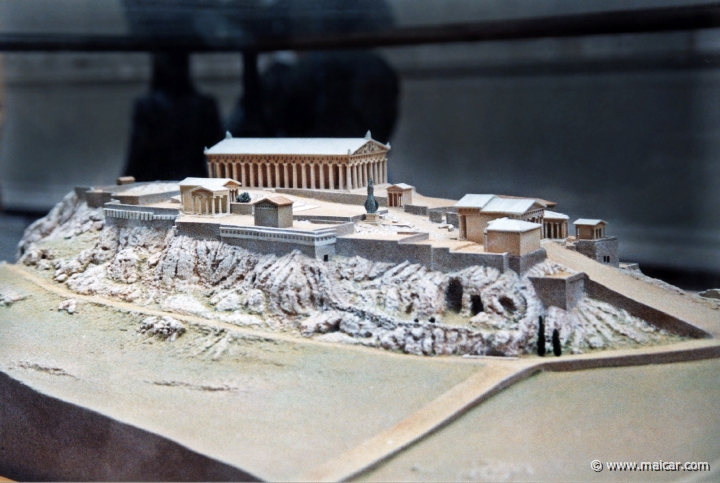
7920: Acropolis of Athens. Designed by M. Korres. Constructed by P. Demetriades and G. Angelopoulos. British Museum, London.
|
|
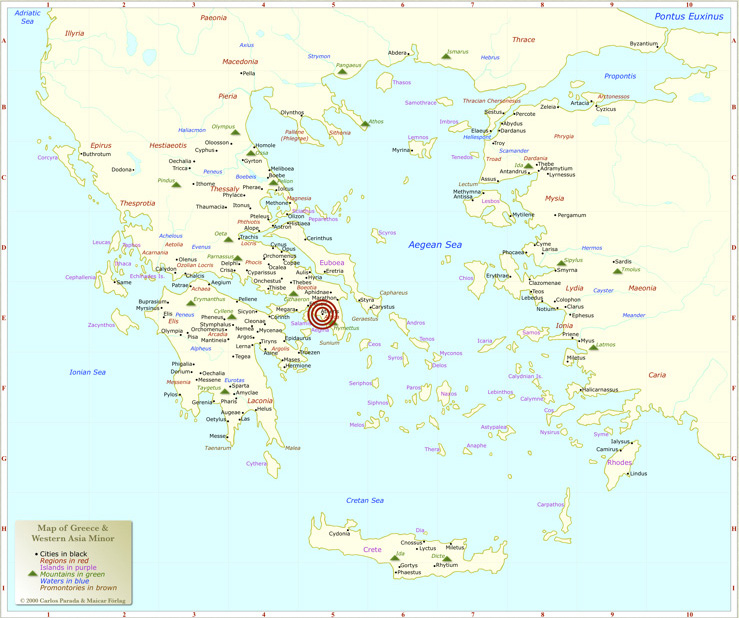
Athens is a city in Attica in mainland Greece; the natives are called Athenians. The district of Attica was formerly called Acte or Actaea in the time of Actaeus 1, and Cecropia in the times of Cecrops 1, since tyrants usually love to call many things after themselves. The Athenians do not belong originally to any of the primary families (see Three Main Ancestors), and are mostly called "sons of the soil" (AUTOCHTHONOUS). A descendant of Deucalion 1 (Amphictyon) took over power in Athens for twelve years, but otherwise the "sons of the soil" ruled almost without interruptions until Melanthus 1 became king (see Throne Succession at the end of this article).
First King
Some have mentioned Colaenus as first ruler of Attica, but others say that the first king of Attica was Actaeus 1, and that he reigned before The Flood in the age of Deucalion 1. His daughter Aglaurus 1 married Cecrops 1, who in this way inherited the throne and became the first king of Athens.
Cecrops 1
King Cecrops 1, who had a body compounded of man and serpent, was a so called "son of the soil," although sometimes he is called son of Gaia. The land which was formerly called Acte, he named Cecropia after himself. During his time, the gods competed with each other to gain the patronage of the cities. In Athens this competition took place between Poseidon and Athena (see these). Because Cecrops 1 witnessed that Athena had been the first to plant the olive, the twelve gods who had been appointed as arbiters by Zeus, decided in her favor. Some say that Cecrops 1 was a pious king because he was the first to acknowledge Zeus as the Supreme God, and refused to sacrifice anything living, but instead burnt cakes on the altar. He was a contemporary of the utterly impious Lycaon 2, who sacrificed a human baby on the altar of Zeus. Cecrops 1 had by Aglaurus 1 one son Erysichthon 1 and three daughters: Aglaurus 2, Herse 2 and Pandrosus. Erysichthon 1 never inherited the kingdom since his father survived him. Since there was no heir, Cranaus, another "son of the soil" (see AUTOCHTHONOUS) but in reality the most powerful of the Athenians, came to the throne, and it was during his reign that The Flood in the age of Deucalion 1 took place.
Cranaus dethroned by Amphictyon
Cranaus married the Lacedaemonian girl Pedias, who gave birth to Cranae 1, Cranaechme and Atthis. When Atthis died in her youth, Cranaus called the country Atthis after her. Cranaus was dethroned by Amphictyon, something for a son-in-law to do, for Amphictyon was Atthis' husband. However, some say that Atthis died a maid. Cranaus fled from Athens to Lamptrae, another location in Attica, where he died and was buried. Amphictyon was, according to some, a so-called "son of the soil" (see AUTOCHTHONOUS), but according to others he was the son of Deucalion 1 and Pyrrha 1. Amphictyon reigned during twelve years, before he and his seditious rebels were banished by Erichthonius 2.
Erichthonius 2
The parentage of Erichthonius 2 (see also Envy) is uncertain: it has been said that he is the son either of Hephaestus and Atthis, or of Hephaestus and Athena, or of Hephaestus and Gaia, and he also has been called a "son of the soil" (see AUTOCHTHONOUS). It is also said that the lower part of his body was snake-formed. Erichthonius 2 married the Naiad Praxithea 2, and his child by her, Pandion 2, became king of Athens when Erichthonius 2 died.
Pandion 2
It is during the reign of Pandion 2 that both Demeter and Dionysus 2 came to Attica, the former being welcomed by Celeus 1, king of Eleusis, and Dionysus 2 by Icarius 2. Under Pandion 2, Athens was at war with Thebes, which at the time was ruled by Labdacus 1 (grandfather of Oedipus) for a matter of boundaries. For the purpose of defeating the Thebans, Pandion 2 asked military assistance from the Thracian king Tereus 1, who helped to bring the war to a successful close. But Tereus 1, having received from the grateful Pandion 2 one of his daughters as wife, seduced the other daughter, pretending the first was dead: Tereus 1, after marrying Procne, fell in love with her sister Philomela 1. He seduced her, saying that Procne was dead while concealing her somewhere in the country. So he married Philomela 1, but cruel as he was, he cut out her tongue. Yet, by weaving characters in a garment, she revealed to Procne her own grief. Having found her sister, Procne killed her son Itys 1, boiled him, and served him up for dinner to the unwitting Tereus 1. After this horrible deed the sisters fled, pursued by Tereus 1. On being overtaken at Daulis in Phocis, the sisters prayed to the gods to be turned into birds, and Procne became a nightingale, and Philomela 1 a swallow. Tereus 1 also was changed into a bird, turning into a hoopoe.
Erechtheus
At the death of Pandion 2, his sons divided their inheritance, Erechtheus becoming king of Athens, and Butes 2 receiving the priesthood of Athena and Poseidon. During the reign of Erechtheus, war broke out against the Eleusinians. Erechtheus inquired of the oracle how the Athenians might win victory, and the oracle answered that they would win the war if he would sacrifice one of his daughters. When this was done, his other daughters killed themselves, having taken an oath to perish together. On the Eleusinian side, there was Eumolpus 1, who attacked Athens because, as he put it, that land belonged to his father Poseidon. However, he was defeated and killed by Erechtheus along with Eumolpus 1's son Ismarus 2, who commanded the troops. Some say that Poseidon demanded then that Erechtheus' daughter be sacrificed to him, so that Erechtheus would not rejoice at the death of Eumolpus 1. In any case Chthonia 1, Erechtheus' daughter, was sacrificed. And some affirm that Zeus killed Erechtheus with a thunderbolt at Poseidon's request.
Cephalus 1 and Procris 2
Apparently, not all daughters perished on that occasion. At least not Procris 2, with whom King Erechtheus had committed incest. Procris 2 married Cephalus 1, who some call King of Athens. But she let herself be bribed by a golden crown, taking a lover. Having being detected by Cephalus 1, she fled to King Minos 2 of Crete. But also Minos 2 fell in love with her. The case was that if any woman made love to Minos 2, it was impossible for her to escape with life, because Minos 2 had been bewitched by her wife Queen Pasiphae, and whenever he took a mistress, he caused her death. But Minos 2 had a Swift Dog and a Dart-That-Flew-Straight. Accepting these wonderful gifts, Procris 2 let herself be bribed again, and became his mistress. However, she took care to make him drink the Circaean root so that he might not harm her. After some time, fearing the queen, she returned to Athens and to her husband Cephalus 1, with whom she was reconciled. But later, while they were hunting Cephalus 1 accidentally killed her with the aforementioned Dart-That-Flew-Straight.
Cephalus 1 in exile
|
|
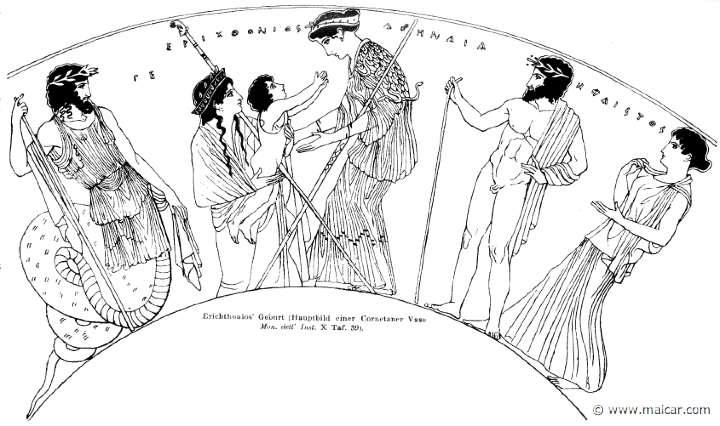
RI.1-1305: Birth of Erichthonius. Gaia holds the child and Athena receives it. Behind Athena is Hephaestus. To the left, King Cecrops. Wilhelm Heinrich Roscher (Göttingen, 1845- Dresden, 1923), Ausfürliches Lexikon der griechisches und römisches Mythologie, 1884.
|
|
For this death, Cephalus 1 was tried in the Areopagus, found guilty, and banished. Cephalus 1 settled in Thebes where he met another exile, Amphitryon, and together they waged war against the Taphians, who lived in the islands off the coast of Acarnania. The island of Cephallenia is called after this Cephalus 1, father of Arcisius, father of Laertes, father of Odysseus, king of Ithaca and Cephallenia.
Cecrops 2, Pandion 4 and the sons of Metion 1
The successor of Erechtheus was Cecrops 2, the eldest of his sons. Cecrops 2 married Metiadusa, daughter of Eupalamus, son of Erechtheus. Cecrops 2 was succeeded by his son Pandion 4, who reigned in Athens until he was expelled by the sons of Metion 1, and having emigrated to Megara, he was later proclaimed king of that city.
Aegeus 1
The sons of Metion 1 were in turn expelled by Pandion 4's son Aegeus 1, who then became king. Aegeus 1 consorted with Aethra 2, who gave birth to Theseus, and later married Medea, by whom he had a son Medus. During the reign of Aegeus 1, Athens had to pay a hard tribute to Crete (see Aegeus 1, Theseus, Crete and Minotaur). The expedition of Theseus to Crete liberated Athens from this subjection, but Aegeus 1, believing Theseus to be dead, threw himself into the sea and perished. (See Theseus and Helen to read about the fate of Aethra 2, Theseus' mother.)
Menestheus 1
Because of his adventure with Helen, Theseus lost the kingdom, and Menestheus 1 became king of Athens, while Theseus, as an exile, went to Scyros (the island in the Aegean Sea northeast of Euboea) where he met his death. Menestheus 1 was son of Peteos. This Peteos was originally an Egyptian, who later obtained Athenian citizenship. Peteos was pursued during the reign of Aegeus 1 and migrated from Attica to Phocis. However, some say that Peteos' father was Orneus 1, after whom Orneae (a city west of Mycenae) was called, and that Orneus 1 was son of Erechtheus. Menestheus 1 was one of the SUITORS OF HELEN, and being bound by The Oath of Tyndareus, he became leader of the Athenians against Troy. After the sack of Troy, Menestheus 1 went to Melos and reigned as king, because the king there, Polyanax, had died.
Demophon 1
The throne was then inherited by Demophon 1, son of Theseus and Phaedra. Also Demophon 1 fought in the Trojan War, and he is one of those who hid inside the WOODEN HORSE. After the war, Demophon 1 asked Agamemnon for the freedom of his grandmother Aethra 2, and Agamemnon granted his request, having received Helen's consent (Aethra 2 had become Helen's slave). Demophon 1 is usually blamed for the suicide of Phyllis 1, daughter of the king of the Thracian Bisaltians, to whom he made love promises. Demophon 1 was himself thrown off by his horse, fell on his sword and died.
Thymoetes 2 and Melanthus 1
The last of the Athenian kings descended from Theseus was Thymoetes 2, son of Oxyntes. Thymoetes 2 was deposed by Melanthus 1, who had been expelled from Messenia by the HERACLIDES Temenus 2 and Cresphontes. Melanthus 1 was son of Andropompus 1, son of Borus 3 (also expelled from Messenia by the HERACLIDES), son of Penthilus 2, son of Periclymenus 1, son of Neleus, a descendant of Deucalion 1 and founder of Pylos.
Colonization of Ionia
After Melanthus 1, Codrus 1 became king of Athens. During his reign the Peloponnesians made an expedition against the city, and in the war that ensued Codrus 1 was killed. His son Medon 11 succeeded him on the throne. Otherwise the sons of Codrus 1 began the Ionian colonization of Asia Minor: Neileus was leader of an expedition; Androclus has been called founder of Ephesus; Cyaretus founded Myus (a city in Caria, southern Asia Minor); Damasichthon 3, one the Ionian leaders, was killed by his brother Promethus, who himself died in Naxos; Andraemon 5 founded Lebedus in Caria; and Naoclus, a bastard son of Codrus 1, led an Attic contingent of Ionian colonists in Asia Minor.
|
|
|

|
|
Actaeus 1
|
|
Cecrops 1
|
|
Cranaus
|

|
|
Amphictyon
|
|
|
|
Erichthonius 2
|
|
Pandion 2
|
|
Erechtheus
|
|
Cecrops 2
|
|
Pandion 4
|
|
THE SONS OF Metion 1
|
|
Aegeus 1
|
|
|
|
Theseus
|
|
Menestheus 1
|
|
Demophon 1
|
|
(perhaps other kings in between)
|
|
Thymoetes 2
|
|
|
|
Melanthus 1
|
|
Codrus 1
|
|
Medon 11
|
|
|
|
Actaeus 1. The first king of what became Attica. He is the father of Aglaurus 1 (Apd.3.14.2; Pau.1.2.6).
Cecrops 1 had a body compounded of man and serpent. He was the first king of Athens and under his kingdom the country was adjudged to Athena. He received the kingdom from Actaeus 1 who had ruled in Attica, after marrying his daughter Aglaurus 1. Aglaurus 1 gave birth to Erysichthon 1, Aglaurus 2, Herse 2 and Pandrosus. Erysichthon 1 died before his father. Some have said that Cecrops 1 is a son of Gaia (Apd.3.14.1-2; Hyg.Ast.2.29; Hyg.Fab.48; Lib.Met.6; Nonn.41.59; Pau.1.2.6).
Cranaus was AUTOCHTHONOUS. When King Cecrops 1 of Athens died, Cranaus came to the throne. It was in his time that the Flood in the age of Deucalion 1 took place. Later he was expelled by Amphictyon, who reigned in his stead while he died in exile at Lamptrae in Attica. Cranaus married Pedias, a Lacedaemonian daughter of Mynes 1, and had children by her: Cranae 1, Cranaechme, and Atthis, after whom the country was called Attica (Apd.3.14.5-6; Pau.1.2.6, 1.31.3).
Amphictyon is sometimes called son of Deucalion 1 & Pyrrha 1. Deucalion 1, son of Prometheus 1, is the man who survived the Flood. Amphictyon expelled Cranaus from the throne of Athens, became king of Attica and was in turn expelled by Erichthonius 2. Amphictyon married Atthis, after whom the country was called Attica, which before was named Actaea. According to some, however, Atthis, who was the daughter of King Cranaus & Pedias, daughter of Mynes 1, a Lacedaemonian, died a maid. Amphictyon is father of Itonus 1, father of Boeotus, after whom the Boeotians are called. He is also said to have a daughter who consorted with Poseidon giving birth to Cercyon 1, a bandit killed by Theseus. Amphictyon's Daughter, whose name is unknown, is also said to be, by a man called Rarus, the mother of Triptolemus, the young man who received from Demeter a chariot of winged Dragons and wheat with which, flying through the sky, sowed the inhabited earth, teaching the art of growing crops (Apd.1.7.2, 3.14.6; Pau.1.2.6, 1.14.3, 5.1.4).
Erichthonius 2. The lower part of Erichthonius 2's body was snakeformed, as it was the case with Cecrops 1 (see above). Erichthonius 2 became king of Athens after having expelled Amphictyon. Some say that Erichthonius 2 was not a son of the soil but that his father was Hephaestus, and some call his mother Atthis, others Gaia, and still others Athena. These add that Athena brought him up unknown to the other gods, and that when Erichthonius 2 died he was buried in the same precinct of Athena where he had been brought up by the goddess. Erichthonius 2 married the Naiad Praxithea 2 and their son was Pandion 2, who became King of Athens after the death of his father (Apd.3.14.6-7; Eur.Ion.21; Hyg.Ast.2.13; Hyg.Fab.48, 166; Pau.1.2.6).
Pandion 2. King of Athens after the death of Erichthonius 2, his father. Pandion 2's mother was Praxithea 2, a Naiad (see NYMPHS). He married Zeuxippe 2, his aunt, and had children by her: Procne, Philomela 1, Erechtheus, and Butes 2 (see also Tereus 1). Pandion 2 died before Old Age came to its full term (Apd.3.14.6-8; Hyg.Fab.48; Ov.Met.6.675).
Erechtheus. King of Athens after his father Pandion 2, son of Erichthonius 2, either son of Hephaestus or AUTOCHTHONOUS. His mother was Zeuxippe 2. During his reign war broke out against the Eleusinians. Erechtheus then inquired of the oracle how the Athenians might be victorious, and the god answered that they would win the war if he would sacrifice one of his daughters. But when he did so, the other daughters killed themselves, as they had taken an oath to perish together. During the war Erechtheus killed Eumolpus 1, who fought for the Eleusinians. This man was son of Poseidon, and for his death Zeus killed Erechtheus with a thunderbolt at Poseidon's request. Erechtheus has been also reported to have come as captain of the Athenians to join Dionysus 2 in his war against the Indians. By Praxithea 4, daughter of Diogenia 1, daughter of Cephisus (one of the RIVER GODS) Erechtheus had children: Cecrops 2, Pandorus, Metion 1, Procris 2, Creusa 1, Chthonia 1, Orithyia 2, Sicyon, Orneus 1, Thespius, Eupalamus, and Merope 8. He had an incestuous relationship with his daughter Procris 2, who gave birth to Aglaurus 3 (see also Athens) (Apd.3.14.8, 3.15.1, 3.15.4; Dio.4.29.2, 4.76.1; Hyg.Fab.46, 253; Nonn.13.171, 22.296ff.; Pau.2.6.5, 2.25.6; Plu.The.19.5).
Cecrops 2. Succeeded to the throne of Athens after his father Erechtheus. His mother Praxithea 4 was daughter of Phrasimus and Diogenia 1, daughter of the river god Cephisus. Cecrops 2 married Metiadusa, daughter of Eupalamus, and had by her a son Pandion 4 who reigned in Athens after his father (Apd.3.15.1, 3.15.5)
Pandion 4 reigned in Athens after his father Cecrops 2 but was expelled by the sons of Metion 1 and emigrated to Megara, where he was appointed king of the city. His mother was Metiadusa (daughter of Eupalamus) and his wife was Pylia; by her he had children: Aegeus 1, Pallas 5, Nisus 1, Lycus 7, and a daughter (see also Megara) (Apd.3.15.5; Pau.1.39.6; Strab.9.1.6).
Metion 1. Son of King Erechtheus of Athens and Praxithea 4. Eupalamus is sometimes called son of Metion 1 and sometimes father of Metion 1. Metion 1 is also called father of Sicyon and Daedalus. His sons (but all three are given other parentages as well) are said to have expelled Pandion 4 from the throne of Athens (Apd.3.15.1, 3.15.5, 3.15.8; Dio.4.76.1; Pau.2.6.5).
Aegeus 1, after whom the Aegean Sea is called, became king of Athens, but, having difficulties to make a little prince who could inherit his throne, he married several women, including a sorceress and criminal. Aegeus 1 was son of Pandion 4 & Pylia, or of Scyrius. He married first Meta and afterwards Aethra (by whom he begot Theseus and Clymene 6), and Medea (by whom he fathered Medus) (Apd.1.7.2, 1.9.28, 3.15.5-7; Apd.Ep.1.5, 1.11; Dictys 6.2; Dio.4.61.6; Eur.Med.1386 and passim; Eur.Supp.6; Hdt.1.173; Hyg.Fab.26, 43; Pau.1.5.4, 1.27.8; Plu.The.12.2, 22.1; Strab.1.6).
Theseus, king of Athens, punished the bandits that infested the road between this city and Troezen; he slew the Minotaur in Crete, and thanklessly abandoned the woman who had helped him. He also cursed his son, carried off another woman, and having descended to the Underworld, sat there on the Chair of Oblivion. He died in exile, but when he still was a ruler, he piously aided the Argives in recovering for burial the bodies of those who had fallen during the war of the SEVEN AGAINST THEBES. Theseus was son of Aethra 2, his father being either Aegeus 1 or Poseidon (Apd.1.8.2, 1.9.16, 3.15.8; Apd.Ep.1.7, 1.18, 1.24; Cic.ND.3.45; CYP.11; Dio.4.28.3, 4.59.1; Eur.Hcl.208; Eur.Her. passim; Eur.Hipp. passim; Eur.Supp. passim; Hes.SH.181; Hom.Il.1.265; Hyg.Ast.2.5, 2.6, 2.7; Hyg.Fab.14; Lib.Met.27; Ov.Fast.3.460ff.; Ov.Met.12.227; Pau.1.17.6, 2.22.6-7, 10.25.7; Plu.Cim.8.5; Plu.PS.34; Plu.The.8.2, 20.2, 29.1-4, 31.3, 35.4; QS.13.497, 13.518; Soph.OC.1154 and passim; Stat.Theb.5.432).
Menestheus 1. Establishing a model that was later used in historical times, Menestheus 1 was appointed king in Athens by the DIOSCURI, who were Spartans. This happened because of Theseus' abduction of Helen which caused the Peloponnesian armies to invade Attica (see Theseus). Menestheus 1 was son of Peteos, who migrated from Attica to Phocis when pursued by Theseus' father Aegeus 1. Peteos, some say, was originally an Egyptian, who later obtained Athenian citizenship. But Peteos is also called son of Orneus 1, who was son of Erechtheus, a pure Athenian (see Athens). Menestheus 1 is among those who hid inside the WOODEN HORSE (Apd.3.10.8; Apd.Ep.1.23, 6.15b; Hes.CWE.68.42; Hom.Il.2.536ff., 2.552; Pau.1.23.8; QS.12.314ff.).
Demophon 1, son of Theseus and Phaedra, is counted among those who hid inside the WOODEN HORSE. After the war he asked Agamemnon for the freedom of his grandmother Aethra 2, who after the misadventure of Theseus with Helen and the destruction of Aphidnae by the DIOSCURI, had become Helen's maid. Agamemnon granted his request after receiving Helen's consent. On his return from Troy, Demophon 1 came with a few ships to the land of the Thracian Bisaltians. There he became the lover of the king's daughter Phyllis 1, and her father gave her to him with the kingdom for her dowry. However, the wedding could not take place immediately because Demophon 1 wished to return to Athens, but he swore to return. When he departed Phyllis 1, who was desperately in love with this man, made with him part of the road and when they parted company she gave him an enchanted casket containing a sacrament of the Mother of the Gods, which he was not to open until he knew for certain that he would not return to Thrace. Some say that he should had returned on an appointed day, and that on that day Phyllis 1 ran down to the shore nine times to see whether his sail showed up. When it became clear that Demophon 1 would not return, she hanged herself after cursing her lover. It is also said, however, that she died out of longing for him, and that round the tomb that her parents made for her, trees sprang that, at a certain season, grieve for her, their leaves growing dry and blowing away. And then again some say she prepared her own epitaph:
"Demophon sent Phyllis to her doom. Her guest he was, she loved him well. He was the cause that brought her death to pass. Her own the hand by which she fell." (Ovid, Heroides 2.145).
In any case it is said that she thought that this would be a good inscription to be written under the image of Demophon 1 in Athens:
"This is he whose wiles betrayed the hostess that loved him." (Ovid, Heroides 2.75).
By the time Phyllis 1 died Demophon 1 was in Cyprus, and so soon he opened the casket she had given him he felt invaded by panic. So, out of control, he mounted his horse, and when the animal stumbled he was thrown, fell on his sword and died (Apd.Ep.1.18, 6.17; Dio.4.62.1; Eur.Hcl.115 and passim; Hyg.Fab.48; LI.13; Lib.Met.33; Pau.1.23.8, 10.25.7; Plu.Sol.26.2; QS.12.314ff.; SI.4; Try.177).
Thymoetes 2. The last of the Athenian kings descended from Theseus. He was deposed by Melanthus 1, who had been expelled from Messenia by the HERACLIDES. Thymoetes 2 was son of Oxyntes (Pau.2.18.9).
Melanthus 1. Son of Andropompus 1, son of Borus 3, son of Penthilus 2, son of Periclymenus 1, son of Neleus. Melanthus 1, who was king of Messenia, was expelled from the city by the HERACLIDES, Temenus 2 and Cresphontes. He then went to Athens and deposed Thymoetes 2, becoming king himself. Melanthus 1 is father of Codrus 1, whose sons colonized Ionia (Pau.1.19.5, 2.18.8).
Codrus 1. King of Athens an father of many sons, most of them colonizers of Ionia in Asia Minor. These were: Neileus, Androclus, Cyaretus, Damasichthon 3, Promethus, Andraemon 5, Naoclus, Cleopus, Medon 11 (successor of Crodus 1), Cydrelus, and Cnopus. Codrus 1 was son of Melanthus 1, a king of Messenia expelled by the HERACLIDES, himself son of Andropompus 1, son of Borus 3, son of Penthilus 2, son of Periclymenus 1, son of Neleus. Codrus 1 was killed by the Peloponnesians, when these attacked Attica. (Hdt.1.147, 9.97; Pau.1.19.5, 1.39.4, 7.2.1, 7.2.8, 7.2.10, 7.3.3, 7.3.5-7; Strab.9.1.7, 14.1.3).
Medon 11. King of Athens, son of Codrus 1 (Pau.7.2.1).
|
|
| Related sections |
Theseus, Helen, Minotaur, Crete, Map of Greece, Envy |
|
|
Sources
Abbreviations |
Apd.1.7.2, 1.9.28, 3.10.8, 3.14.1-2, 3.14.5-8, 3.15.1, 3.15.4-7; Apd.Ep.1.5, 1.11, 1.23, 6.15b; Dio.4.29.2, 4.61.6, 4.76.1; Eur.Ion.21; Eur.Med.1386 and passim; Eur.Supp.6; Hdt.1.173; Hes.CWE.68.42; Hom.Il.2.536ff., 2.552; Hyg.Ast.2.13, 2.29; Hyg.Fab.26, 43, 46, 48, 166, 253; Lib.Met.6; Nonn.13.171, 22.296ff., 41.59; Ov.Met.6.675; Pau.1.2.6, 1.14.3, 1.19.5, 1.23.8; 1.31.3, 1.39.4, 1.39.6, 2.6.5, 2.18.8-9, 2.25.6, 5.1.4, 7.2.1.; Plu.The.19.5; QS.12.314ff.; Strab.9.1.6-7, 14.1.3. Other mentions of Athens: Apd.1.8.2, 1.9.28, 2.4.7, 2.8.1, 3.7.1, 3.14.1, 3.14.6, 3.15.4, 3.15.6, 3.15.7, 3.15.8, 3.16.1; Apd.Ep.1.4, 1.11, 1.16, 1.23, 1.24, 3.11, 6.25; Hom.Il.2.546, 2.551, 2.556, 4.328, 13.196, 15.337; Hom.Od.3.278, 3.308, 7.80, 11.323; Hyg.Fab.14, 26, 37, 39, 40, 41, 42, 45, 46, 79, 97, 130, 164, 173a, 238, 274; Nonn.1.134, 13.150, 13.180, 19.82, 19.116, 22.319, 24.95, 24.240, 27.299, 27.306, 28.126, 28.148, 38.54, 39.211, 47.311, 47.350, 47.428, 47.439, 48.966; Ov.Met.5.652, 6.421, 7.507, 7.723, 8.262. See also Theseus
|
|
|