|
|
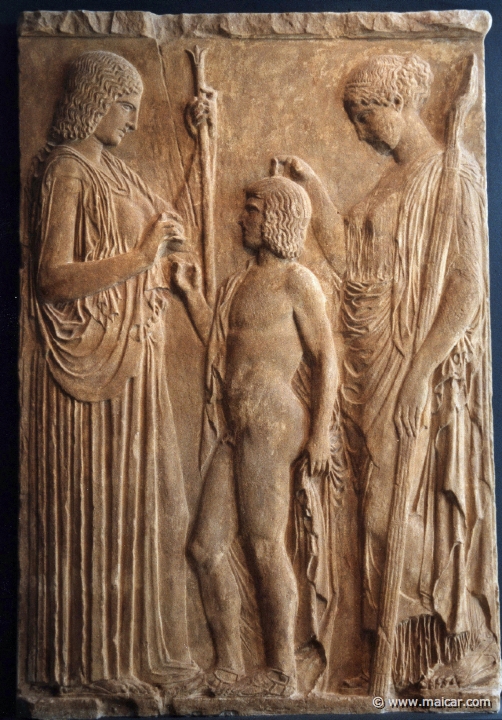
6433: Copy of Eleusinian relief, ca. 440 BC, depicting Demeter, Triptolemus and Persephone. Original in marble at the National Archaeological Museum, Athens. Archaeological Museum of Eleusis.
|
|
|
"Are we to believe, then, that vines, not previously existing, appeared at a certain stage; and olives, likewise, and the gifts of Demeter and Core? And that some Triptolemus was the minister of such fruits?" (Plato, Laws 782b).
|
|
Triptolemus received from Demeter seeds and a
chariot of winged dragons, with which he, flying
through the sky, sowed the whole inhabited earth.
This is the story of Triptolemus in a nutshell; and
whereas some have believed it, others have analysed
it, none of them going farther than the other. And
since the story is about something else, still
others have done neither.
Demeter's darkest day
Persephone, the
sweet girl who loved to gather flowers, was
abducted by Hades, lord of
the dead, and taken by him to the Underworld, where she became his wife. This was the darkest moment of Demeter, the girl's
mother; and since not even the gods could help her,
she, unable to find consolation, quitted Heaven and
went about seeking her daughter all over the earth,
carrying torches by night and by day.
Demeter in Eleusis
In her wanderings, Demeter came to Eleusis, where King Celeus 1 ruled. Having become the nurse of Queen Metanira's babe Demophon 2, the goddess attempted to make him immortal by setting the child on the fire during the night. But a servant, having discovered her manipulations, spoiled Demeter's work with a shriek of terror, and the babe was consumed by the fire. Others say that the king of Eleusis was Eleusinus,
and that Demeter, pretending to be a nurse, took care of Triptolemus (instead of Demophon 2). They assert that the goddess fed Triptolemus by day with divine milk, hiding him by night in the fire. As time went by, Triptolemus grew more than mortals usually do; so the master of the house started to watch Demeter, and when
Eleusinus finally discovered terrified that Demeter was about to put
the child in the fire, the goddess, being caught in
the act, struck Eleusinus dead.
Triptolemus' mission
Until then no one knew that the nurse was a
goddess, but when one of these things happened, Demeter revealed
herself, and having made a one-wheeled chariot
drawn by winged dragons, she gave Triptolemus wheat
to be sowed from the air throughout the earth.
According to some, this is how the goddess rewarded
the information about her daughter that she had
received from Triptolemus.But Triptolemus is
remembered mainly for the goddess' gift, and for
having accomplished his agricultural mission,
spreading the cultivation of grain.
Mythical symbols
A scholar has thought that the wheel "represents the sun", and
that Triptolemus represents the "mythical embodiment of the first
sower", apparently meaning by the expression
"mythical embodiment" that, whereas the sowing
reflects the true part of the story, the "mythical"
(whatever that is) conveys its falsehood. Others
would probably support this view by affirming that
many sowers are known who walk on earth, and yet no
one among them has been seen flying around in a
one-wheeled chariot. Satisfied with such an
evidence, they may then go on to say that wheat was
not really given by a goddess, but that it came out
of other seeds from plants resembling it, which in
turn originated in the course of a long chain of
events that began with a distant explosion, which
occurred, not "once upon a time", but so and so
many billions of years ago, which is before any
other time, since not even Time existed at the
time. And they would be pleased with this story,
and find it more credible.
What Triptolemus learned
Now, if Demeter had taught Triptolemus just agriculture, making him the first sower, then there would not have been any hush-hush. For what a sower does and how he does it, although it may require training, is not that difficult to discover, and Triptolemus was supposed to divulge that art of sowing anyway. But what Demeter taught Triptolemus was mainly "the conduct of her rites" and "all her
mysteries"; and of them it has been said
that they were:
"... awful
mysteries which no one may in any way transgress or
pry into or utter, for deep awe of the gods checks
the voice." (Homeric
Hymn to Demeter 475ff.).
Accordingly Pausanias writes:
"After I had
intended to go further into this story, and to
describe the contents of the sanctuary at Athens, called the Eleusinium, I was
stayed by a vision in a dream. I shall therefore
turn to those things it is lawful to write of to
all men." (Description
of Greece, 1.14.3).
And what is further added about the mysteries
learned by Triptolemus does not appear to refer to
any mythical embodiment of a first sower, unless
one deems it likely that a man, once he is dead,
cares much about agriculture:
"Happy is he
among men upon earth who has seen these mysteries;
but he who is uninitiate and who has no part in
them, never has lot of like good things once he is
dead, down in the darkness and gloom." (Homeric
Hymn to Demeter 480).
|

|
Triptolemus about to depart on his mission. Behind him is Persephone with torches. 6516: Votive relief depicting Triptolemus being sent on his mission. Early 4C BC. Archaeological Museum of Eleusis.
|
|
Agreement in Heaven
When Rhea 1 told Demeter that it had been
agreed in heaven that Persephone should go
to the Underworld for
a third part of the year and then return to be with
her mother for the two remaining parts, the
goddess, recovering her joy, made fruit spring up
from the lands, covering the earth with leaves and
flowers, and imparted her secret teaching to
Triptolemus, Polyxinus, and others.
Various parentages
It has also been pointed out that the accounts
given of the parentage of Triptolemus are "very various", a
circumstance we are advised not to wonder at, since
he was "probably a purely
mythical personage". This friendly advice, however, is given as if myth could fail to cause wonder if the parentages were not very various, or as if a rule existed, establishing that a larger number of parentages is more mythical than a lesser number. Not such rule exists, although it is true that several parentages are attributed to Triptolemus (see below).
Stories about what is not unknown
His distribution of the grain is naturally the
most remembered of his deeds. Not because this was
his only or more important deed, but rather because
this gift of the goddess was known by all, whereas
her other gifts were kept secret. Therefore,
several stories refer to the distribution of the
grain, and none to the rest.
Some who received the grain
For example, it is told that among those who received the cultivated corn from Triptolemus, was Eumelus 4, the first man to settle in the land of Patrae in Achaea. While Triptolemus was there, Eumelus 4's son Antheias yoked the dragons to the car, when its owner was asleep, and tried to sow the seed himself. However, he fell off the chariot and died, wherefore Triptolemus and Eumelus 4, in memory of the latter's son, founded the city Antheia near Pylos. Also Arcas 1, the son of Zeus and Callisto who civilized Arcadia, teaching men to make bread, to weave clothes, and other things, learned the cultivation of crops from Triptolemus. Some upset chronology by asserting that the
first strangers to whom Triptolemus revealed the
rites of Demeter and Persephone were Heracles 1 and the DIOSCURI, but perhaps
they just mean that it was upon the Peloponnesus
that Triptolemus first bestowed Demeter's seed, saying
"Heracles 1" and
"DIOSCURI" as a way of
calling the region by the name of its dearest
children.
Triptolemus ambushed
Triptolemus, while distributing his grain, came
to Thrace, where King Carnabon of the Getae,
received him, at first hospitably. But soon, at the
king's order, Triptolemus was ambushed, and one of
the dragons was killed, so as to make it impossible
for him to escape in his chariot. But as they say, Demeter substituted
another dragon, and punished Carnabon by picturing
him among the stars holding a dragon in his hands,
which he is for ever about to kill. The story shows
that becoming one of the CONSTELLATIONS not necessarily is a blessing.
|
|
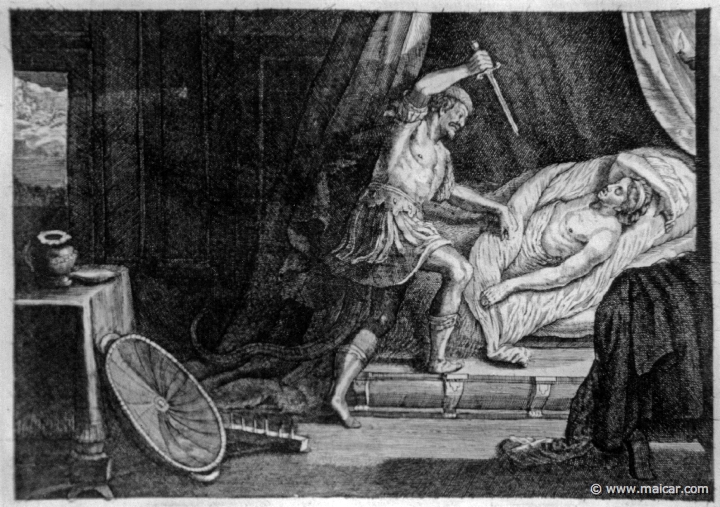
2706: Lyncus and Triptolemus. Les METAMORPHOSES D’OVIDE EN LATIN ET FRANÇOIS, DIVISÉES EN XV LIVRES. TRADUCTION DE Mr. PIERRE DU-RYER PARISIEN, DE L’ACADEMIE FRANÇOISE. MDCLXXVII.
|
|
Fighting to become a benefactor
In similar manner, when Triptolemus came to Scythia to spread the
knowledge of Demeter's grain, King Lyncus 1, after offering him hospitality, attacked him with a sword when Triptolemus was asleep. It has been guessed that the king tried to murder Triptolemus, so that he himself would appear as the giver of corn to mankind, which is not a wild guess, since fights and mutual destruction are not uncommon among benefactors, who seldom refrain themselves in their ambition to appear as great men. In any case, when Lyncus 1 was about to kill his guest, Demeter saved
Triptolemus by turning the king into a lynx.
Triptolemus hated at home
It has also been told that Celeus 1 wished to kill Triptolemus on the latter's return, but when his intentions came to Demeter's knowledge, she
handed over the kingdom to Triptolemus, who called
the city Eleusis after
his father, and established those sacred rites in
honor of Demeter, which
are called Thesmophoria.
No reason for amazing behavior
Now, some may wonder why Triptolemus, a
beneficent visitor, was, in several places,
received with treachery, being on his return to Eleusis threatened to death by King Celeus 1 because of his benefactions. But to search for sound judgement in the behavior of mortals is a vain enterprise, since their nature compels them, with or without a reason, to ceaselessly wage war against each other. And so, either in the hope of attaining pleasures that do not satisfy them, or in order to obtain useless things, they impose upon each other limitless sufferings, thereby securing the loss of the happiness they so eagerly seek.
Judge of the dead
Triptolemus was taken to heaven, and some
believe that he is among the stars. But others
count him among those who judge the dead, since
they say:
"For if a man
when he reaches the other world, after leaving
behind these who claim to be judges, shall find
those who are really judges who are said to sit in
judgment there, Minos and Rhadamanthys, and Aeacus and Triptolemus, and all the other
demigods who were just men in their lives, would
the change of habitation be undesirable?" (Socrates. Plato, Apology 41a).
|


