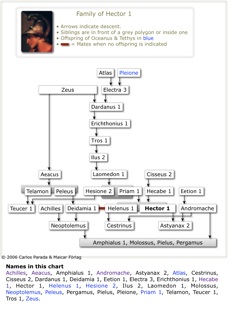
|
Killed by Hector 1
|
|
Amphimachus 1
|
Leader of Elis, son of Cteatus & Theronice.
|
|
Anchialus 1 and Menesthes 1
|
These two were riding the same chariot when Hector 1 attacked them.
|
|
Antilochus
|
Son of Nestor, but some say he was killed by the Ethiopian Memnon.
|
|
Archesilaus
|
Leader of the Boeotians and son of Areilycus 1 & Theobula 1.
|
|
Coeranus 1
|
The squire of Meriones, a leader from Crete.
|
|
Dolops 1
|
son of Clytius 1.
|
|
Epigeus
|
One of the best in the Myrmidon force, son of Agacles.
|
|
Lycophron
|
Son of Mastor 1 and a Cytherian squire of Ajax 1.
|
|
Oresbius 1
|
A rich man who lived in Hyle, a city in Boeotia.
|
|
Periphetes 1
|
A Mycenaean warrior son of Copreus, who was himself son of Pelops 1 and herald of Eurystheus (see also Heracles 1).
|
|
Protesilaus
|
Leader from Phylace, a Thessalian city west of the Gulf of Pagasae; Protesilaus was the first of the Achaeans to land on Trojan soil, and the first of the Achaeans to be killed in the war. But some say that he was killed by a Dardanian leader or by Cycnus 1, ruler of Colonae, a city in the Troad.
|
|
Schedius 1
|
Leader of Phocis, a region bordering the Gulf of Corinth west of Boeotia, and son of the Argonaut Iphitus 2.
|
|
Schedius 3
|
Another Phocian, son of Perimedes 3.
|
|
Stichius
|
An Athenian who carried the body of Amphimachus 1 off the battlefield and later supported Menestheus 1 against the attacks of Hector 1.
|
|
Trechus
|
An Aetolian spearman.
|
|
Hector 1 also killed: Aesymnus, Agelaus 7, Asaeus, Autonous 1, Eioneus 1, Helenus 3, Hipponous 3, Oenomaus 2, Opheltius 2, Opites, Orestes 3, Orus 2, Patroclus 1, and Teuthras 1.
|
|
|
|
Hector 1, of the flashing helm, was the eldest among the children of King Priam 1 of Troy and Hecabe 1. He was
expected to become king of Troy after his father. But
as the city was attacked by the Achaean invaders,
he became the leader of the alliance defending Troy. In the tenth year of the war Hector 1 was killed, and the kingdom that was his inheritance was destroyed.
Unknown childhood of the pillar of Troy
Nothing is told about the childhood of Hector 1 nor on his life before the Trojan War. This man
came to be known for his courageous interventions
during the Trojan War and for being the very fundament of the defence of
the city. And yet some have said that before the Trojan War, Hector 1 came to Hellas, and having taken the city of Troezen, carried away Aethra 2, mother of Theseus, and took her to Troy (for another version of the abduction of Aethra 2 see Helen). Anyhow Hector 1 became the pillar of the city. And when the Achaeans talked, planned or dreamt about the destruction of Troy, they seldom failed to
mention the need of killing its mighty defender, if
that aim was to be achieved.
Thinks his brother is a curse
Hector 1 fulfilled his duty as defender and commander of the troops without hesitation. However, he was visibly annoyed with his brother Paris, who, through the
abduction of Helen, had
caused the conflict that threatened the existence
of Troy. That is why he
could address Paris thus:
"Paris, you pretty boy, you woman
seducer, why were you ever born? Why weren't you
killed before your wedding day?" (Hector 1 to Paris. Homer, Iliad 3.39).
And as Paris was
reluctant to meet Menelaus in single combat, Hector 1 reproached him:
"Can you be
the man who carried off a beautiful woman from a
distant land and warlike family, to be a curse to
your father, to the city, and to the whole people?
Are you too cowardly to stand up to the brave man
whom you wronged? You would soon find out the kind
of fighter he is whose lovely wife you
stole." (Hector 1 to Paris. Homer, Iliad 3.45).
At a later time he would admonish Paris with similar words:
"It is your
fault that this city is invaded by the sounds of
battle." (Hector 1 to Paris. Homer, Iliad 6.327).
Temporary Trojan victory
The Trojans were fated, by the will of Zeus, to win several
victories during the last year of the war. And that
was so, because the god, having heard the prayers
of Thetis, had decided to punish Agamemnon's
pride and the Achaeans for the outrage Achilles had suffered
when his sweetheart Briseis was taken away
from him. And so, while Achilles nursed his
bitter wrath and refused to fight, Zeus gave victory and glory to Hector 1, who killed many warriors, and finally threatened the Achaean fleet.
Pious and temperate man
A pious man was Hector 1, for he would not offer a libation to the gods with unwashed hands, or pray while being bespattered with blood and filth. He was also a temperate man, for he would abstain, during a break in the battle, to drink wine, feeling it would
cripple him, and make him forgetful of his courage.
And yet it was his own mother who offered it with
reasonable words:
"Wine is a great comfort to a weary man;
and you must be exhausted after fighting so hard
for your dear ones." (Hecabe 1 to Hector 1. Homer, Iliad 6.260).
Hector 1 never hesitated and was always dutiful. He never rested when he had tasks in front of him. Also Helen invited him to
a short pause, but he refused:
Helen: Come in now, my dear brother,
and sit down on this chair. No one in Troy has a greater burden to bear than
you, all through my own shame and the wickedness of Paris.
Hector 1: Helen, you are kind, but do not ask me
to sit down. I am late already and anxious to
return and help the Trojans, who miss me terribly
when I am gone.
(Homer, Iliad 6.355).
And this devotion towards his duty, which he recognizes as defence of country and family, does not fade in front of the inevitable disaster, for Hector 1 himself acknowledges that his efforts will be fruitless:
|
|
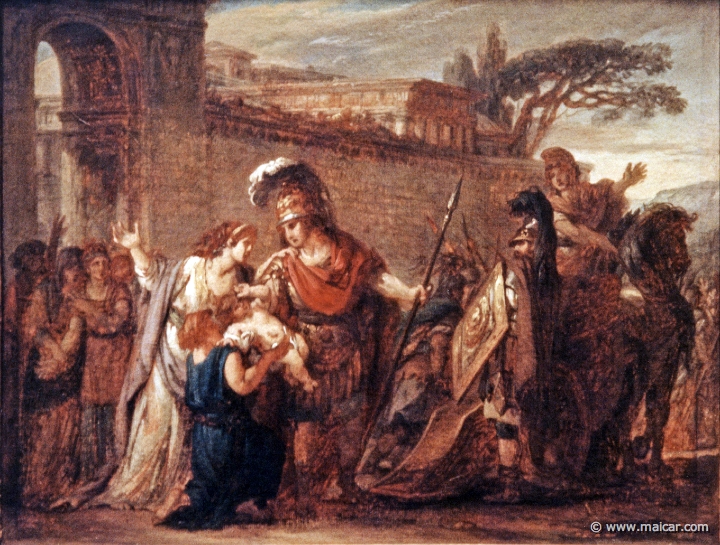
Good-byes of Hector 1 and Andromache. To the right, on horseback, is Paris. 4609: Vien Joseph-Marie 1716-1809: Les adieux d'Hector et d'Andromaque. Musée des beaux arts, Caen.
|
|
"Deep in my
heart I know the day is coming when Troy will be destroyed." (Hector 1 to Andromache.
Homer, Iliad, 6.445).
And, as if a prophetic vision had seized him, he
laments what in fact will take place: the death of
his father and brothers, and Andromache's lost
freedom. Thus, seeing the future as if it were
displayed in front of his eyes, he cannot see the
point in trying to spare his own life, and so
suffer hearing the screams of his own wife as the
enemy drags her off.
Andromache's
appeal
Andromache begs
him to live:
"You, Hector,
are father and mother and brother to me, as well as
my beloved husband. Have pity on me now; stay here
in the city, and do not make your boy an orphan and
your wife a widow." (Andromache to Hector 1. Homer, Iliad 6.430).
But he tells Andromache what he
knows people in a foreign country who see her as
prisoner will say:
"There goes
the wife of Hector, who was the champion of the
Trojans when Troy was besieged". (Hector 1 to Andromache. Homer, Iliad 6.460).
This proved to be true, for later being in
Hellas she lamented:
"In days gone
by I was a woman to be envied, but now I am, if any
woman ever was, the paragon of misery. I have many
things, not one, to lament, my native land, the
death of Hector, and the hard lot to which I have
been yoked when I fell undeservedly into
slavery." (Andromache.
Euripides, Andromache 5).
And yet, when kissing his little child Astyanax 2, he cannot see his fate and prays to the gods what will prove impossible:
"Grant that
this boy of mine be as strong and brave as I; a
mighty king of Troy." (Hector 1. Homer, Iliad 6.475).
Single combat and the gift of an enemy
In one occasion, Hector 1 and the Achaean champion Ajax 1 fought in
single combat that was without issue because the
heralds parted them as the night was coming. In
recognition of their courage the contenders
exchanged gifts. But, as it is said, the gifts of
enemies bring no good, for Ajax 1 gave Hector 1 the belt by which he was later dragged by Achilles, and Hector 1 gave Ajax 1 the sword with which he killed himself.
|
|
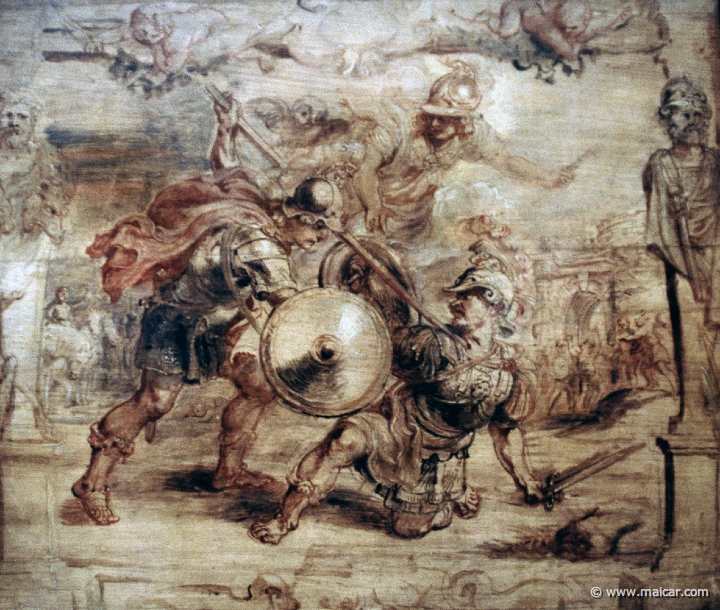
Death of Hector 1. 3922: Peter Paul Rubens 1577-1640: Achilles doodt Hector. Museum Boijmans van Beuningen, Rotterdam.
|
|
Zeus gives glory to Hector 1
Zeus had promised Thetis
to honour her son Achilles, and so the
god showed the Achaeans, through defeat's bitter
lesson, the value of the man they had offended,
letting the Trojans win. Zeus even sent Iris 1 with a message to Hector 1, letting him learn that when Agamemnon would be wounded, that was the signal for him to
attack and slay warriors until he reached the
Achaean ships.
Does not believe in omens
However, when this was about to happen and the Trojans were preparing to break the Achaean defence and were standing at the trench ready to cross, a portent appeared to them. They saw an eagle holding a blood-red snake in his talons. The snake was alive, and suddenly it bit the eagle on the breast, and the bird had to drop it before he reached his nest. Some Trojans understood this omen thus: that even if they succeeded in breaking the Achaean wall, they would not be able to set the ships afire, that many warrior would die, and that finally they would have to return to the city without having achieved complete victory. But Hector 1, who felt he had been promised glory by Zeus, said that he was not
to base his actions on the flight of birds, and so
he gave the signal to advance.
Zeus looks away
And in fact that was Hector 1's day of glory and victory, for the defences were broken and the Achaeans were driven in rout among the ships. Having achieved this, Zeus turned his eyes elsewhere, deeming that no other
god would ever dare to intervene, as he had
strictly forbidden them to help anybody in battle.
But Poseidon, seeing
that Zeus' attention was
not in the battlefield, came to where the fight
was, and assuming the seer Calchas' shape, gave the Achaeans renewed courage. When Zeus discovered what had happened, and that even the life of Hector 1 had been in danger, he soon reestablished the line of action he had decided, letting the Trojans reach the Achaean ships and Hector 1 win a victory, in order to fulfill the prayer of Thetis. But Zeus was only waiting for
the glare of a burning ship; for from that time
forth, he would grant glory to the Achaeans, and
let the Trojans be defeated.
Death of Patroclus 1
When one of the ships caught fire, Achilles perceived the
gravity of the situation, and letting go a part of
his wrath, he let his friend Patroclus 1 go into battle with a force of Myrmidons. But as it had been predicted, Hector 1 killed Patroclus 1, who
before dying said:
"You too, I
swear it, have not long to live. Already Destiny
and Death are very close to you, and you will die
at the hands of Achilles." (Patroclus 1, dying, to Hector 1. Homer, Iliad 16.850).
When Hector 1 had killed Patroclus 1, he
intended to behead the corpse, drag it off, and
give it to the dogs of Troy, but the body was
finally retrieved by the Achaeans. Yet he kept Achilles' armour, which Patroclus 1 had worn.
Achilles honoured,
and yet disappointed
All these dead Achaeans were in fact the work of Zeus, for the god punished
them for having offended Achilles. And yet Achilles could now say:
"It is true
that Zeus has done that much in my behalf.
But what satisfaction can I get from that, now that
my dearest friend Patroclus is dead? I have no wish to live
unless Hector falls by my spear and dies." (Achilles to his
mother Thetis. Homer, Iliad 18.80).
Now it became clear for Thetis that all her
efforts to honour her child led to his destruction,
and that is why she, weeping, warns him a last
time:
"If that is
so, you surely have not long to live; for after
Hector's death you are doomed to die
immediately." (Thetis to Achilles. Homer, Iliad 18.95).
But death is nothing to Achilles now, for he
feels that his wrath had transformed him into an
idle burden, and that he failed to save his friend
and many others from death. So after having
received a new armour from Hephaestus and having
put and end to his feud with Agamemnon, he went in search of Hector 1 and death.
Hector 1 decides to meet destiny
|
|
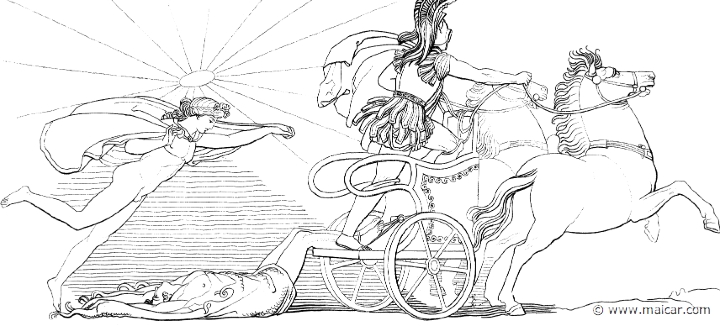
Achilles dragging the body of Hector | il439flax: "Neither would he fail to mark the Dawn, as she shone over the sea and the sea-beaches, but would yoke beneath the car his swift horses, and bind Hector behind the chariot to drag him withal; and when he had haled him thrice about the barrow of the dead Patroclus, he would rest again in his hut, but would leave Hector outstretched on his face in the dust. But Apollo kept all defacement from his flesh, pitying the warrior even in death, and with the golden aegis he covered him wholly, that Achilles might not tear his body as he dragged him." (Hom.Il.24.15. John Flaxman (1755 – 1826).
|
|
Hector 1 was not less decided to meet his own fate. So he said to the Trojans:
"I am going to
meet Achilles, though his hands are like fire,
and his heart like steel." (Hector 1. Homer, Iliad 20.370).
It is not decisive who was stronger, because as
they saw it, these things were in the knees of the
gods, and it may very well happen that heaven lets
the weaker man win. For in fact, no one can tell on
whose head fortune will land next time. King Priam 1 tried to
dissuade his son from fighting a man, son of a
goddess, far stronger than himself. And the same
did his mother Hecabe 1,
who exhorted him to fight within the walls of the
city, instead of meeting the savage Achilles in single combat. They resorted both to reason and tears, but all their entreaties were wasted on this son, and they failed to shake Hector 1's resolution. And yet when the crucial moment approached and Hector 1 was waiting for Achilles, many doubts
appeared in his thoughts: Should he had withdrawn
the army when Achilles came to life again? Would not the Trojans say that
he trusted his own arm and lost his army? Could he
not make overtures to Achilles, and for
example, deliver Helen and
the property Paris stole
from Sparta? Could he not
propose to share all the rest of the Trojan
possessions with the Achaeans?
Thoughts of a man in danger
Many things may be thought by a man in danger, trying to figure up how the present nightmare might be averted. So there was almost no thought or possible solution that Hector 1 did not consider at that moment. And he even thought of inducing his countrymen to swear in council that they would hide nothing, but divide all the Trojan property in two equal parts, to be shared with the enemy. For peace, agreement, and sharing, which seldom awake enthusiasm when they in daily life are taken for granted, become the object of profound longing when they are lost.
|
|
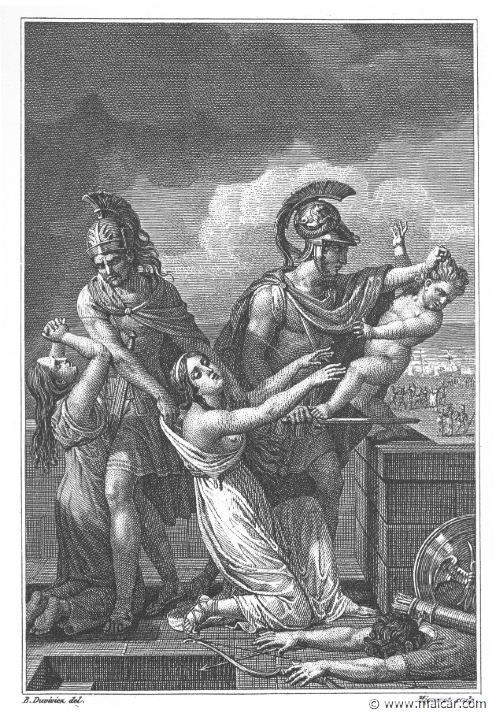
The Achaeans murder little Astyanax 2, the son of Hector 1. 02169: Death of Astyanax. "And Astyanax was hurled down from that tower where he was wont often to sit and watch his father." (Ov. Met. 13.415). Guillaume T. de Villenave, Les Métamorphoses d'Ovide (Paris, Didot 1806–07). Engravings after originals by Jean-Jacques François Le Barbier (1739–1826), Nicolas André Monsiau (1754–1837), and Jean-Michel Moreau (1741–1814).
|
|
Courage may fail the bravest
Hector 1's inward debate was followed by the kind of prophetic inspiration he had in his dialogue with his wife Andromache (see above). When he caught sight of Achilles, feeling that something terrible was about to happen, he began to tremble, and losing heart he ran away in terror. So the combat started like a race with Hector 1 in front and Achilles behind, pursuing him round the city of Troy. So they went on until Zeus, lifting his golden scales and weighing their sentences of death, saw the side of Hector 1 come down, spelling his doom. Then Apollo, who up to that point had protected Hector 1, deserted him, and Athena, who wished to
help Achilles, assuming the shape of Deiphobus 1, brother of Hector 1, came to him and convinced him of making a stand and face Achilles, both
together, she said.
Death
That is how Hector 1 finally decided to stop running and fight. But very soon, having discovered that there was no Deiphobus 1 by his side, Hector 1 realized that the gods had fooled him, that death was not far away, and that he was about to face his doom. This came quickly, for Achilles' lance wounded him mortally in the neck. In vain Hector 1 begged Achilles not to give
his body to the dogs. And as if men became prophets
in front of death he said to Achilles:
"Your heart is
hard as iron. Nevertheless, pause before you act,
in case the angry gods remember how you treated me,
when your turn comes and you are killed at the
Scaean Gate by Paris and Apollo." (Hector 1 to Achilles. Homer, Iliad 22.355).
Body outraged
The soul of Hector 1 descended to Hades lamenting, as
they say, its lot and the youth it was leaving, but
his body Achilles outraged in a shameful way. He pierced the tendons
at the back of his feet from the heel to the ankle,
and having inserted leather straps (the belt of Ajax 1), he bound them to his chariot, leaving the head to trail. And having done this, he drove the chariot in front of the walls and round the city, while the head of Hector 1 tumbled against the ground. It was not before hard negotiations, during a
humiliating meeting with King Priam 1, that Achilles accepted the body to be ransomed by the father of the man he had killed. When Hecabe 1 was
taken away as a prize by Odysseus from the
sacked Troy, she carried the ashes of her son, for
it has been chanted:
Yet Hector's
ashes from his urn she bore,
And in her bosom the sad relic wore:
Then scatter'd on his tomb her hoary hairs,
A poor oblation mingled with her tears.
(Ovid, Metamorphoses 13.425).
Epilogue
In such a way fell he who had been the first
among the Trojan warriors, and the one who was to
become king of Troy, had
not the city been destroyed. His wife Andromache was given
as a prize to Achilles'
son Neoptolemus, and had a child Amphialus 1 by him. At Neoptolemus' death, Andromache married Helenus 1, a seer and brother of Hector 1, who became king of Epirus. Little Astyanax 2 was thrown down by the Achaeans, from the battlements at Troy. Some say that Neoptolemus performed this deed, but others say that it was Odysseus who murdered little Astyanax 2. However, in spite of all rumours about his death, he is also said to have been taken by Neoptolemus and
later allowed to return home from Hellas, becoming
king of Scepsis, a place near Mt. Ida, not far away
from Troy.
Another with identical name
Hector 2 is a king of Chios. |