 |
|
|
|
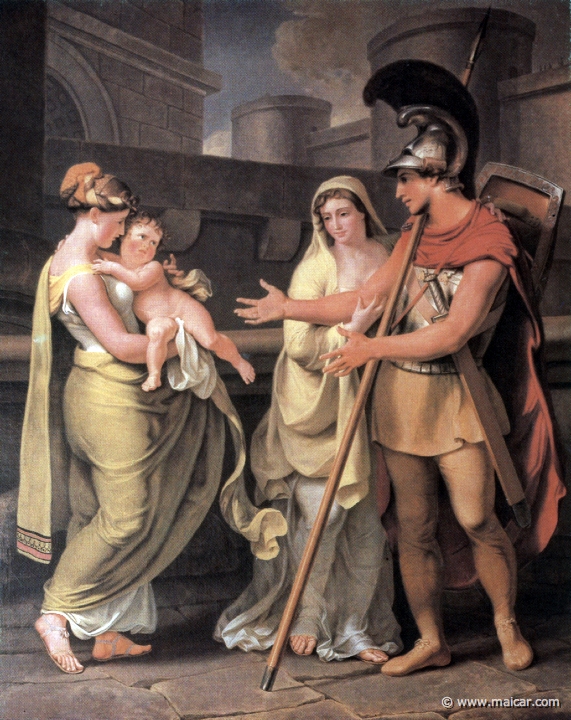
Andromache and Hector 1. 3635: Johann Heinrich Wilhelm Tischbein, 1751-1829: Hektors Abschied von Andromache 1812. Landesmuseum Oldenburg, Das Schloß.
|
|
|
"How many thousands nobodies there are whom Fame blows up to importance and authority. Heaven bless the man whose splendid reputation is based on truth; but when it lives by lies, I am not deceived; Fame hides an empty fabric of pretence and luck." (Andromache to Menelaus. Euripides, Andromache 320).
"Nothing makes arrogant people angrier than being worsted in argument by the weaker party." (Andromache to Hermione. Euripides, Andromache 189).
|
|
Andromache, remembered as Hector 1's loving wife, was assigned to Neoptolemus at the end of the Trojan War. Having become by force her enemy's concubine, she bore his children in Epirus, the Adriatic coastal region of Hellas, between the Ambracian Gulf and Illyria (Albania), where Neoptolemus was king. After the death of Neoptolemus, who was murdered by Orestes 2 on account of their dispute over Helen's daughter Hermione, Andromache married her first husband's brother Helenus 1, whom Neoptolemus had also brought from Troy to Epirus. At the end of her life, Andromache returned to Asia with one of her sons.
Trojan dynasties
There are times when great empires break down into pieces, and times when nations come together to form federations or build empires anew, and then again, after some time, they disintegrate, leaving each section to find its own way. Agamemnon was the leader of the great host that sailed against Troy because he was the most powerful king in the West; and although there were many kings and dynasties in Hellas, he was their overlord. And as it was in the West, so was in the East; for Trojans were called those who were under the sway of Priam 1, whether they came from the city of Troy or not. Thus there are those who have counted nine dynasties, which recognized Priam 1 as their overlord and which, taken together, ruled a large part of the coastal regions of Asia Minor and beyond.
Her city and father
Achilles sacked twelve cities himself, among which was Thebe, where Chryseis 3 was captured. It was she whom Agamemnon kept, refusing to give her back to her father and humiliating the man who came as a suppliant and was a priest of Apollo. Thereby Agamemnon called upon himself the wrath of the god, who, coming from heaven darker than night—although he is called the bright one—decimated the Achaean army by plague. In this city of Thebe was born Andromache, her father being King Eetion 1; but when Achilles sacked the city and killed the king, Andromache, having married Hector 1, was already living in Troy.
Her views
By marrying the crown prince of Troy, Andromache won renown, first in Phrygia, and then in the whole world and for all times. For her husband was, during the war, the pillar of Troy, and his courage became proverbial. Andromache was in the eyes of many of too big complexion, and it has been said that only Hector 1 deemed her to be of moderate size. But then beauty is heaven's gift, and very few can boast of it. Believing such to be the nature of things, Andromache did not rely in beauty, but instead believed that it is character that wins a husband's heart. She would therefore never pit her pride against her husband's, for example by praising her own city and belittling his, and would even love his mistresses for her husband's sake. She thought that, by always being a congenial company, she would draw her husband to her. And constancy, loyalty and trueheartedness, some think, cause love to go beyond the sweet pleasures of the couch, so that words like these may be uttered:
"You, Hector, are father and mother and brother to me, as well as my beloved husband." (Andromache to Hector 1. Homer, Iliad 6.430).
Others are otherwise
But others who, like Helen, think, feel and do otherwise, are never mentioned among those regarded as devoted wives. For no one thinks that she, who left her husband and child to follow the seducer Paris, has set an example of loyalty with her deed. And in Andromache's eyes, Helen, being too fond of men, was to blame, not only for the death of Hector 1 and of those Trojans who perished defending the city, but also for the death of Achilles and all other Achaeans who never returned from the war. And the power of such evil women was a puzzle for Andromache:
"How strange that nature provides remedies against deadly snakes, but against a bad woman—deadlier far than snakes, crueller than fire—no one has found a remedy." (Andromache. Euripides, Andromache 269).
And she called Helen, not child of Zeus, but
"Child of the Haunting Curse, of Envy, of Murder, of Death, of all earth-nurtured plagues!" (Andromache. Euripides, Daughters of Troy 769).
Who is to blame
Not seldom women prefer to blame women, and men men. For just as Andromache blamed Helen, her husband Hector 1 blamed Paris:
"It is your fault that this city is invaded by the sounds of battle." (Hector 1 to Paris. Homer, Iliad 6.327).
And yet others blame the gods for the deeds of men and women, and for what happened at Troy:
Cyclops (Polyphemus 2): Disgraceful expedition, to sail for the sake of one woman to the land of the Phrygians!
Odysseus: It was the doing of a god: blame no mortal for it. (Euripides, Cyclops 284).
|

|
Andromache shows little Astyanax 2 to her husband Hector 1 as he departs for battle. print006: Hector and Andromache. A. Maignan, Artist. A. C. Alais, Engraver.
Engraving by Albert Maignan, 1845-1908.
|
|
Soldier's wife
If peace had prevailed, Hector 1 and Andromache would have succeeded Priam 1 and Hecabe 1 on the throne of Troy. But as the war turned things upside-down, father survived son, and later, when defeat followed, the whole royal house was laid in ruins, justifying Andromache's misgivings. For during the war, she had said to her husband:
"Hector ... this bravery of yours will be your end. You do not think of your little boy or your unhappy wife, whom you will make a widow soon ..." (Andromache to Hector 1. Homer, Iliad 6.405).
Hector 1's fears
Yet Hector 1 could not do but his duty and what he had been trained for, that is, act like a good soldier and take his place in the front line, even if he knew, deep in his heart, that the day was coming when Troy should face destruction. Nevertheless, he was concerned about his wife, and tortured by the thought of seeing her dragged off in tears to slavery by some Achaean soldier:
"I see you there in Argos, toiling for some other woman at the loom, or carrying water from an alien well ...'There goes the wife of Hector' they will say when they see your tears. 'He was the champion of the Trojans, when Ilium was besieged.' And every time they say it, you will feel another pang at the loss of the one man who might have kept you free." (Hector 1 to Andromache. Homer, Iliad 6.456ff.).
And as he feared this vision more than death, he added:
"Ah, may the earth lied deep on my dead body before I hear the screams you utter as they drag you off." (Hector 1 to Andromache. Homer, Iliad 6.464).
Zeus knows
This wish was fulfilled, and Hector 1 never had to watch her wife been dragged away. In accordance with what heaven had ordained, Hector 1 killed Patroclus 1, who wore his friend Achilles' armour, and having stripped it from his head and shoulders, he put it on. It has been remarked that Zeus, knowing what should come about, caused the armour to sit easily on Hector 1, saying to himself:
"There will be no home-coming for you from the battle, and Andromache will never take the glorious armour of Achilles from your hands." (Zeus. Homer, Iliad 17.205).
A widow
When Hector 1 died, Troy lost the one pillar indispensable for its sustenance, and Andromache could do nothing but lament; for there is no consolation when hopes must be abandoned and fears come true:
"Husband, you were too young to die and leave me widowed in our home...Ah, Hector, you have brought utter desolation to your parents. But who will mourn you as I shall? Mine is the bitterest regret of all, because you did not die in bed and stretching out your arms to me give me some tender word that I might have treasured in my tears by night and day." (Andromache to her husband's corpse. Homer, Iliad 24.725ff.).
Death better
|

|
Andromache sees Hector being dragged | il407flax: "But when Andromache was come to the wall and the throng of men, then on the wall she stopped and looked, and saw Hector being dragged before the city; and swift horses were dragging him ruthlessly toward the hollow ships of the Achaeans." (Hom.Il.22.460). John Flaxman (1755 – 1826).
|
|
And hardest is the fall for those who have called themselves happy in the company of their beloved, for their cherished looks and gestures and words vanish too quickly when they are gone, and bareness worse than death spreads in the heart. That is why Andromache says:
"... Better death than life in bitterness. No pain feels death, which has no sense of ills: but who has prospered, and has fallen on woe, forlorn of soul strays far from olden bliss." (Andromache to Hecabe 1. Euripides, Daughters of Troy 638).
Remaining comfort
A child is sometimes the one remaining comfort for those who have been left in desolation. But as protection vanished along with her husband, Andromache now fears for her child:
"And I have no hope that he will grow into a man: Troy will come tumbling down before that can ever be." (Andromache.Homer, Iliad 24.727).
Father's Fame ruins son
Andromache's fears heralded what was to take place, for Troy was sacked, her little son Astyanax 2 was murdered, and herself was taken captive by Neoptolemus, son of the man who slew her husband. Little Astyanax 2 was thrown down by the Achaeans from the battlements at Troy, as they wished to annihilate the Royal House of Troy. Some say that Neoptolemus murdered him, but others say that Odysseus did it, or that his word of warning, not to rear a hero's son, prevailed in the Achaean assembly. But as it is a great shame to fear a child, some have wished the epitaph of little Astyanax 2 to read thus:
"This child the Achaeans murdered in time past, dreading him." (Hecabe 1. Euripides, Daughters of Troy 1190).
This is how little Astyanax 2, who had been reared to be a king, was ruined by the fame of his father, who otherwise had protected him, saving many lives besides.
Prisoner
Once Troy was defeated, Andromache, who could have inherited throne and palace, was given as a special award to Achilles' son Neoptolemus, just as Agamemnon received Cassandra, and Odysseus got Hecabe 1. At Thetis advice, Neoptolemus remained two days in the island of Tenedos, which is off the coast of the Troad, and thence he set out for Epirus by land, taking with him Andromache and Helenus 1, seer and son of Priam 1. Neoptolemus settled in Epirus and reigned there, marrying Menelaus' daughter Hermione, and taking Andromache as his concubine. Some believe a man should not love more than one woman, causing his children to have different mothers. If this, in addition, is done in the same house, quarrelling and sorrow are bound to take over. For, they say, experience shows that marriage cannot be shared, and the same is thought to be applicable to all circumstances in which loyalty must be divided.
Foreign sorceress
Now, it happened in Epirus that the concubine Andromache had a child Molossus by Neoptolemus, whereas Hermione, who was his lawful wife, had none. This girl then, began to believe that the foreign woman in her house had made her barren by secret spells, aiming at ousting her from her marriage and later replace her as lawful wife. For foreigners are not seldom believed to achieve their secret aims by means of their expertise in such or such kind of devilry, with the help of which they find pleasure in outraging all laws, human or divine. So when Menelaus happened to visit Epirus while Neoptolemus was absent offering at Delphi, Hermione thought that the time had come to murder her rival—a sorceress eager to import foreign morals—with her father's help.
Surrounded by enemies
Andromache then, being again surrounded by enemies, sought refuge in the shrine of Thetis, hoping that Neoptolemus would arrive in time to save her. But Menelaus, a man of great experience and position, now known in the whole world, took Andromache's child as hostage and threatened to cut his throat if she refused to abandon the sanctuary. For he did not regard as a trivial matter to see his daughter be deprived of her rights in marriage. And when, under such a threat, Andromache left the shrine, Menelaus declared that he would put her to death, and that Hermione should decide, regarding Molossus, as she pleased: either to kill him or not.
Peleus saves her
However, when Menelaus, having thus joined lies, treachery and cruelty to his criminal intentions, was about to murder Andromache, Neoptolemus' grandfather Peleus arrived with troops, and held the Spartan king's hand. This is how Andromache was saved by Achilles' father. Menelaus left, and soon after Hermione joined Orestes 2. For Menelaus had had two words concerning his daughter, promising her first to his nephew Orestes 2, and later at Troy, to Neoptolemus. And Hermione was happy to leave; since she feared that Neoptolemus would punish her for plotting against Andromache during his absence.
Marries her brother-in-law
Neoptolemus himself never return to Epirus, for Orestes 2 appeared with an armed force at Delphi and killed him. Some say that Hector 1's brother Helenus 1, who had first married Achilles' wife Deidamia 1, succeeded Neoptolemus on the throne. After the death of Deidamia 1, Helenus 1 married Andromache, who bore him a child Cestrinus.
Return to Asia
On Helenus 1's death, Molossus became king. Then Pergamus, son of Neoptolemus and Andromache, crossed into Teuthrania, a region near Mysia in Asia Minor and, having killed its despot Arius 2 in single combat, gave his name to the city that is still called after him. Andromache then, following her son, returned to Asia, where a shrine dedicated to her in the city of Pergamum could still be seen in historical times.
|
| Family |
|
|
|
|
|
|
|
|
Eetion 1 was king of Thebe, a city to the east of Mount Ida in Asia Minor. He was killed by Achilles
during the sack of Thebe; yet
Achilles, they say, was chivalrous enough not to despoil him, but instead let his body be burnt wearing his arms. One son of Eetion 1, called Podes, was killed by Menelaus
during the Trojan
War. Otherwise Andromache's brothers
are said to have been seven, and to have
all died on the same day, when
Achilles took
the city of Thebe. Andromache's mother,
who was captured by
Achilles and
later ransomed by the Trojans, died of
sickness before the end of the war.
|
|
|

Astyanax 2
|
Little Astyanax 2 was thrown down by the Achaeans, from the battlements at Troy. However, in spite of
all rumours about his death, he is also said to
have been taken by
Neoptolemus and
later allowed to return home from Hellas, becoming
king of Scepsis, a place near Mt. Ida, not far away
from Troy.
|
|
|
Amphialus 1
Molossus
Pielus
Pergamus
|
Molossus inherited the kingdom of Epirus after
the death of Helenus 1.
It is said that Pergamus crossed into Asia and killed Arius 2, despot of Teuthrania, who fought with him in single combat for his kingdom. He gave his name to the city which is still called after him.
|
|
|
|
When Helenus 1, on
his death, passed on the kingdom to Molossus,
Cestrinus with a contingent of volunteers, invaded
and took possession of the region beyond the river
Thyamis, which is in Epirus.
|
|
|
|
|
|

|
Genealogical Charts
Names in this chart: Achilles, Aeacus, Amphialus 1, Andromache, Astyanax 2, Atlas, Cestrinus, Dardanus 1, Deidamia 1, Eetion 1, Electra 3, Erichthonius 1, Hecabe 1, Hector 1, Helenus 1, Ilus 2, Laomedon 1, Lycomedes 1, Molossus, Neoptolemus, Nereus, Peleus, Pergamus, Pielus, Pleione, Podes, Pontus, Priam 1, Thetis, Tros 1, Zeus.
|
|
|
| Related sections |
Hector 1, Neoptolemus |
|
|
Sources
Abbreviations |
Apd.3.12.6; Apd.Ep.5.23, 6.12.; Eur.And.4 and passim; Eur.Tro.273 and passim; Hom.Il.6.395ff.; Hyg.Fab.123; Ov.AA.2.645; Pau.1.11.1; QS.1.99, 13.266, 14.21; Strab.13.1.7, 13.1.27; Vir.Aen.3.295.
|
|
|

