|
|
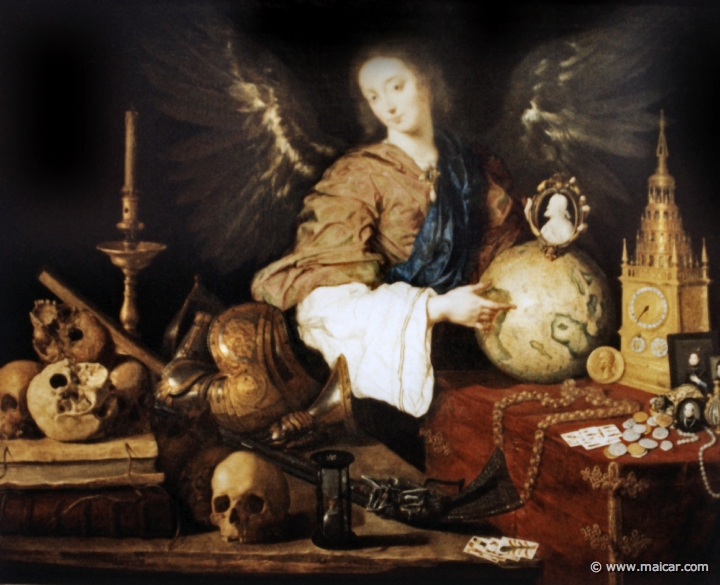
0628: Allegory of transience. Painting by Antonio de Pereda 1611-1678. Künsthistorische Museum, Wien.
|
|
Chronos is Time.
Chronos and Cronos
The name Chronos appears on occasion, but he is
not seldom identified with Cronos, who once ruled
the universe but now is said to rule Elysium.
Chronos (but not Cronos)
is called the father of the HORAE (regarded as Hours
instead of Seasons), of Aether (Upper Sky), and of Eros.
Time rules perception
Chronos is Time, a god who has never been underrated. For all-consuming Time, who for the human mind increases endlessly, cannot in any way be separated from the orderly experience of life, which is not conceivable without him. Therein lies the power of this god, who rules, not only the appearance of things—making them look newer or older—but also the Soul, who would not be
capable of apprehending anything without his gifts.
That is why it has been said:
"Ever-ageing
Time teaches all things." (Prometheus 1 to Hermes. Aeschylus, Prometheus
Bound 982).
Time plants in the human mind the basic sequence of Past, Present and Future, without which there would neither be "before" nor "after", nor anything depending on these, such as "causes" and "effects". Without them, all things would be perceived at once, and the human mind would fall into confusion. The greatness of Time is such that nothing can be done about him, except to take him for granted just in the way he pleases to appear. For if he shortened the length of the day, no one would notice anything, since there is no way of checking Time by means of comparison. Similarly, if he reversed his course, the whole physical world would be altered, since causes and effects are dependent on Time's direction; and then Death would come before
birth, and Old Age would precede youth and childhood (see also AUTOCHTHONOUS).
The first to exist
The immensity of the power of Time is such that
there have been those—as Orpheus (if the Argonautica were his)—who have asserted that Time was the first to exist. For they could not imagine any beginnings without him, apparently reasoning that whatever happens must happen according to Time, and that nothing could ever take place as an event, without the acquiescence of this god, "father of days" (Euripides, Suppliants 786). But Time cannot be found in the physical world, except for the effects of his actions. Effects are perceived always in the segment of Time called "Present", but causes could be either in the past or in the future.
The Fourth Dimension
By reason of this god's greatness, he was once nicknamed "The Fourth Dimension", a pseudomythical expression that attempts to make Time more visible. By associating him to the three space dimensions of length, breadth and thickness (which cannot even be enumerated without the assistance of the fourth), he is expected to appear more tangible, although space itself could be thought to be as elusive as Time. In this simple context, it has been rightly remarked that it is helpful for those wishing to meet, say at Times Square in New York, to think in four coordinates, if the meeting is ever to take place.
Orpheus and the Big
Bang
Those who in the 20C AD described the so called "Big Bang" appear to think, almost like Orpheus, that Time was
the first to exist, since they seem to associate
this
pseudomythical-idea-with-the-onomatopoeic-denomination
to the birth of Time. But whereas Orpheus says that Time was the first to exist, those narrating the story of the "Big Bang" think rather that something took place, or was, just before the appearance of Time. For the universe, they appear to reason, counts a priori with a singularity, or is itself one, and it is not before this singularity expands that Time comes into being. Furthermore, this event may be thought to have taken place "Nowhere", since not only Time but the other three coordinates needed for every event to occur, are absent. Accordingly, the universe-singularity is described as "infinitesimally small and infinetely dense", a curious condition recalling the idea of "Nothing".
Irregularities of Time
In recent years, scientists, who are unsurpassed in examining the physical nature of the universe, and in opening thereby the way to unprecendented technological achievements, claimed to have caught Time running slower or faster, depending just on physical conditions. This discovery has been considered a milestone. For until then Time had been detected running irregularly only in the realm of the human mind. And this experienced time, although recognized and distinguished from physical time, has often been regarded as an illusion, and therefore its meaning, in regard to human life and experience, is usually discarded. Yet nothing could be said to stand closer to Time than the mind. This nearness is such that some have believed Time to exist just "within", being basically the way in which the mind observes the world. But others believe that Time has his own existence "without", independent of the mind and even independent of events. Yet "within" and "without" could be proved difficult to tear apart.
Time, Memory and
events
Time can only be perceived through events, some of which happen before, and some after. Both what took place before (the Past) and what is yet to happen (the Future) are usually regarded as non-existing. Past and Future cannot be retrieved at will, except by Memory, or in the
claims of seers and prophets, or in the accounts of
descents to the Underworld, or in the "time-machines" of fiction. But since perception has been found, on the ground of physical observation, not to be instantaneous but delayed, some emphasize that it is not the Present that is perceived at any moment, but the Past, even though we perceive it "now". As for the Present, common experience says it vanishes instantly and cannot be grasped, suggesting that Time does not exist. Yet Memory confirms him at
every moment, by recalling old events, and thereby
re-establishing the certainty that new ones will
soon come forth. This is how Memory, sister of
Time, cooperates with her brother within the realm
of the human mind.
Eternity
Besides the three temporal dimensions of Time—Past, Present and Future—all of which belong to the experience of the human mind, a fourth may be added through reasoning, speculation, intuition, or other means. This is Eternity, and in this form Time ceases to express himself as the agent of the transient; for what is "eternal" is forever. So, what only happens temporarily in our world, in Eternity happens always or just Is. The Eternal is therefore a world in which Becoming has turned into Being, Change into Sameness, Part into All, Perishable Existence into Eternal Life, Somewhere into Everywhere, and so on:
"... 'Was' and 'Shall be' are generated forms of Time, although we apply them wrongly, without noticing, to Eternal Being. For we say that it 'is' or 'was' or 'will be,' whereas, in truth of speech, 'is' alone is the appropriate term; 'was' and 'will be', on the other hand, are terms properly applicable to the Becoming which proceeds in Time, since both of these are motions; but it belongs not to that which is ever changeless in its uniformity to become either older or younger through time, nor ever to have become so, nor to be so now, nor to be about to be so hereafter, nor in general to be subject to any of the conditions which Becoming has attached to the things which move in the world of Sense, these being generated forms of Time, which imitates Eternity ..." (Plato, Timaeus 38a).
And since Eternity is not divided into segments,
as the Temporal is (in Past, Present, and Future),
there is no need for Memory as such in that
world. For she is the necessary giver of knowledge
in the Temporal dimension, whereas in Eternity
knowledge is absolute. Likewise, the Eternal could
be said to be Time's absolute form, whereas the
Temporal represents his relative form. The role
attributed to Time, "the
all-seeing" (Sophocles, Oedipus
Tyrannus 1212), in both the Eternal and the Temporal dimensions, justifies what is said of him:
"Time sees all
things forever." (Sophocles, Oedipus
at Colonus 1454).
The Past revered
These are some of the reasons why Time has been and still is revered. But of all three temporal categories only the Past is regarded as loaded with Time. For neither in the Present nor in the Future can the footprints of Time be easily perceived. And when anything shows the marks of Time, it may, for that sole reason, be praised and respected. For the human mind may find a merit in age itself, and may cling to ideas such as "tradition", on the ground of the experience and knowledge they may entail. And the longer the tradition the better; for if Time were pushed far enough into the Past, then we would find only the gods; for these came first and humans after. Yet, tradition may sometimes imply a corruption
of Memory; and no one
comes closer to the gods on the ground of
tradition. For they were strange gods, who let
themselves be lured (as if they were humans), by
displays of earthly power and ancestry. In fact,
several among the few being punished in Hades, were close
related to the gods. For the ALOADS were sons of Poseidon, or at least his grandsons; Amphion 1 was a son of Zeus, and so were Tantalus 1 and Tityus; Ascalaphus 2 was son of a river god, and Thamyris 1 was the grandson of a god. As for the TITANS they may be said
to be gods themselves. So finally, there just
remain Ixion and Sisyphus, both farther
removed from the gods than any of the others.
Time trusted
Although Time brings Old
Age and Death, he
is nevertheless revered in yet other ways. There
are those who equate him to money, but then they do
the same with everything else. Others trust him
mainly because "Time purges all things ..." (Aeschylus, Eumenides 285), or because "Time is a god who brings ease ..." (Sophocles, Electra 179), or because he unveils truth:
"Only one
thing, they say, competes in value with life, the
possession of a heart blameless and good. But as
for the base among mortals, they are exposed, late
or soon, by Time, who holds up to them, as to a
young girl, a mirror." (Phaedra to the women of Troezen. Euripides, Hippolytus 425).
And when someone is in pain, it is often said as
consolation: "Time will heal you ..." (Euripides, Alcestis 380), but for those who have lost all hope only Death is seen as
bringer of relief:
"Heracles: You have lost a noble wife. Who
will deny it?
Admetus: And so I
shall have no more joy in life.
Heracles: Time will soften the pain. Now it
is still intense.
Admetus: Time, yes, if
by time you mean Death." (Euripides, Alcestis 1083).
Time everyday
In the eyes of mortals, Time is primarily the
sequence of Past, Present and Future. Time is for
them the same as Life; when Time leaves, so does
life, and Death arrives
in whatever form. For Time and life cannot be put
apart. And if Time is feared, or trusted, is mainly
not so much because of Time himself but for the
events he may bring, many of which are inevitable. The Past is the segment of Time that cannot
undergo change, except by the variations of Memory, on which it
entirely depends. The Present, which vanishes
permanently without ever exhausting itself, is a
challenging meeting with Time, on occasions managed
by Boredom, Indifference and Forgetfulness, on
others by Enthusiasm, Wonder and Engagement. The
Future is the segment of Time that is unknown
(except for the claims of seers, prophets and the
like), and for that reason it may be awaited either
with Hope or with Anxiety, or with neither; for it
might not arrive. The events brought by Time is
what actually happens; that may be, in several
instances, called Fate. How Time and the events he
brings are met, is the way in which life is lived;
this depends completely on the disposition of the
Soul.
|



