|
|
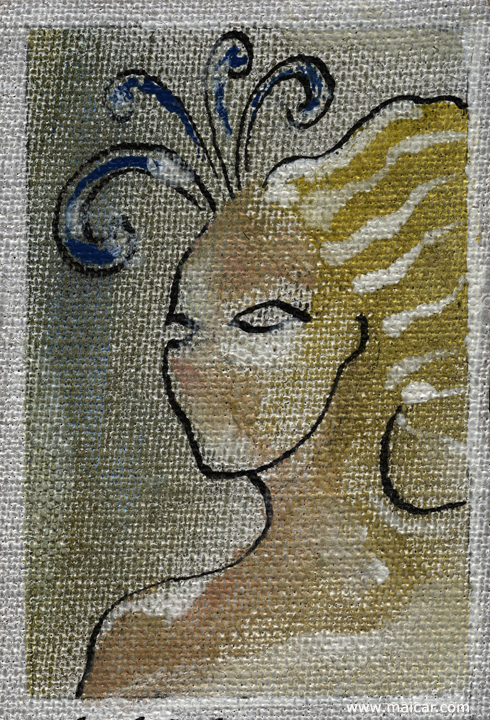
Mnemosyne, mother of the MUSES. Painting by C. Parada (1989)
|
|
|
"If someone is successful in his deeds, he casts a cause for sweet thoughts into the streams of the Muses. For those great acts of prowess dwell in deep darkness, if they lack songs, and we know of only one way to hold a mirror up to fine deeds: if, by the grace of Mnemosyne with her splendid headdress, one finds a recompense for toils in glorious song." (Pindar, Nemean Odes 7.11).
"... and in addition to the gods you mentioned I must call upon all the rest and especially upon Mnemosyne. For practically all the most important part of our speech depends upon this goddess ..." (Critias to Hermocrates. Plato, Critias 108d).
"Please assume ... that there is in our souls a block of wax, in one case larger, in another smaller, in one case the wax is purer, in another more impure and harder, in some cases softer, and in some of proper quality...Let us, then, say that this is the gift of Memory, the mother of the Muses, and that whenever we wish to remember anything we see or hear or think of in our own minds, we hold this wax under the perceptions and thoughts and imprint them upon it, just as we make impressions from seal rings; and whatever is imprinted we remember and know as long as its image lasts, but whatever is rubbed out or cannot be imprinted we forget and do not know."
(Socrates to Theaetetus. Plato, Theaetetus 191d).
"... If you had no memory you could not even remember that you ever did enjoy pleasure, and no recollection whatever of present pleasure could remain with you ..." (Socrates to Protarchus. Plato, Philebus 21c).
|
|
Golden-robed Mnemosyne is Memory.
Mnemosyne's gifts
This Titaness of beautiful hair discovered the
uses of the power of reason, and gave a designation
to every object, which is of the utmost importance,
since without names very little could be expressed,
and mortals would not be able to hold conversations
with each other. But above all, she made available
to them the power to remember, a great faculty upon
which rest many others.
Her daughters
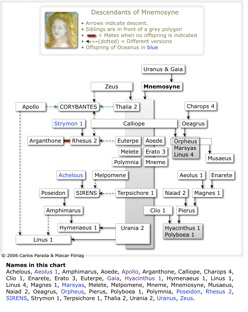
It is told that before Hera became Zeus' wife, the god, taking
the form of a shepherd, consorted with Mnemosyne,
whose domain is in the hills of Eleuther, lying
with her nine nights. And when time passed,
Mnemosyne gave birth to nine daughters, the MUSES, who some affirm were born in this order: first Calliope, then Clio 1, Melpomene, Euterpe, Erato 3, Terpsichore 1, Urania 2, Thalia 2, and Polymnia.
She owns all tales
This is about all that has been told about
Mnemosyne, for there are no tales recording other
deeds. Yet she owns all tales, and these could not
exist without her power, since each narrating word
would vanish without leaving a trace as soon as it
appears if Memory would not preserve them.
No survival without her
Some have suggested that it is natural to see
Memory honoured by illiterate societies; for such
communities, being immerse in what is called oral
tradition, never commit anything to writing, and
rely on minstrels and others like them, who know
everything by heart. However, neither society nor
individuals, whether literate or not, could survive
without Memory.
Knowing oneself and others
For if someone were deprived of the gift of Memory, he would neither know who he is nor what he is. And if he happened to be given this knowledge, he could not retain it, and each moment would appear before him as if it were the first instant of his life, feeling, thinking, and acting much like a newborn. Then if Memory came to him so that he could remember who he is and what he normally does, but did not assist him in other regards, he would not, for example, be able to recognize other people. Accordingly, he would have to make the acquaintance of his loved ones every new instant of his life, incapable of remembering either names or faces, or how he is related to them. Consequently, the meaning of such words as mother, or son, or wife would have to be explained to him over and over again, and there would be no hope that he would retain what he is told. For, deprived of Memory, he would not be able to learn anything permanently.
Organizes Time in the
human mind
Now, if Memory would allow him to recognize himself and other people as well as objects around him, but nothing else, then he would still have no idea about how things are connected to each other, and he would ignore causes and effects, not being able to distinguish between "before" and "after." For even if Time may be
assumed to corrode Memory, she is Time's best organizer.
But there is no Time for
the mind that cannot remember.
|
|
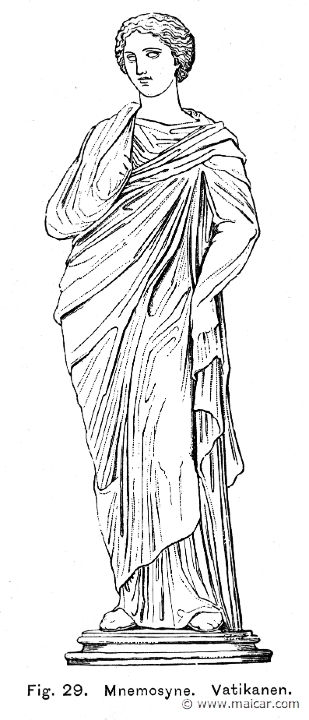
see066: The Muse Mnemosyne. Vatican. Otto Seemann, Grekernas och romarnes mytologi (1881).
|
|
Great goddess at all times
This is why Mnemosyne is a great goddess, not
only in the illiterate era when mistrels sang
relying on what they found printed in their hearts,
but at all times. For the mere act of being could
not be apprehended without her; and man, in order
to be, must be able to remember that he is, lest
his very identity vanishes behind the clouds of
inexplicable confusion. And once he remembers who
he is, he still needs Memory in order to acquire
and practise any science, art, or skill. For also
knowledge is inseparable from Memory, by which all
things that are and have been may be learned and
recalled.
Memory and Letters
Consequently, the collection of past events called "History" is also evoked through her, making it possible to chant:
Holy Memory,
reveal
the glories of yore:
how Spartans and Athenians
won the Persian war.
Athens met them on the sea,
and Sparta held the land,
although the Persian forces were
more numerous than sand.
(Aristophanes, Lysistrata 1250).
And "the father of History" Herodotus wrote his
work in order to preserve the collective or
external memory, opening his work thus:
"These are the
researches of Herodotus of Halicarnassus, which he
publishes, in the hope of thereby preserving from
decay the remembrance of what men have done
..." (1.1).
But others, concerned about the individual or internal memory of man, feared that the written letters could promote forgetfulness. Letters, the story goes, were invented by the Egyptian god Theuth, who also invented numbers, arithmetic, geometry, astronomy, draughts, and dice. Theuth came to Thamus (the god who then ruled Egypt), and showing him his new inventions, suggested that they should be taught to all Egyptians. Thamus commented in detail the different sciences that had been invented by Theuth. Later, when they discussed the letters, Theuth presented them thus:
"This
invention, O king, will make the Egyptians wiser
and will improve their memories; for it is an
elixir of memory and wisdom that I have
discovered." (Plato, Phaedrus 274e).
But since he who judges and he who produces
seldom are of the same opinion, Thamus answered:
"This
invention will produce forgetfulness in the minds
of those who learn to use it, because they will not
practice their memory. Their trust in writing,
produced by external characters which are no part
of themselves, will discourage the use of their own
memory within them. You have invented an elixir not
of memory, but of reminding; and you offer your
pupils the appearance of wisdom, not true wisdom,
for they will read many things without instruction
and will therefore seem to know many things, when
they are for the most part ignorant and hard to get
along with, since they are not wise, but only
appear wise." (Plato, Phaedrus 275b).
|