|
|
|
|
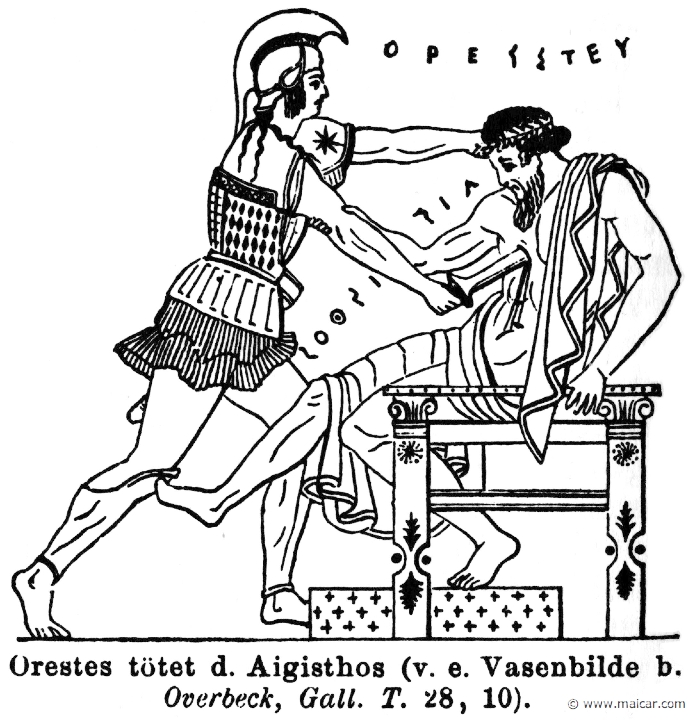
Orestes 2 killing Aegisthus. RI.1-152: Orestes killing Aegisthus (from a vase, Roscher, 1884).
|
|
Aegisthus was the son of his own sister. He restored his father Thyestes 1 to the throne of Mycenae by killing his uncle Atreus. He never went to the Trojan War. Instead he took the wife and the throne of Agamemnon, the commander in chief of the Achaeans, during his absence. And although Agamemnon was far mightier, he succeeded in murdering him at his return from Troy, reigning in Mycenae for seven years until he was himself slain by Agamemnon's son Orestes 2.
The Curse of Myrtilus
Tantalus 1 was punished by the gods for having betrayed their trust and having reached a high pitch of perversion. But his son Pelops 1, whom he boiled and served as a meal, was saved by the gods and loved by them. Pelops 1 migrated from Asia Minor and came to Hellas, where the Peloponnesus was called after him. For he, they say, was rich and courageous, and although a foreigner, came to a position of great power. But on his way up, Pelops 1 committed a crime and was cursed by the man he murdered. And on account of this misfortune, his descendants perpetrated against each other all kind of cruelties, and the Mycenaean branch of his house never knew the gifts of Peace.
Unbridled ambition
Those who particularly excelled in folly, cruelty and ambition were his sons Atreus and Thyestes 1 who, as not seldom occur among siblings, could not find justice in their hearts at the hour of dividing their inheritance; and that is why The Curse of Myrtilus affected them and not others among the many children of Pelops 1.
Golden lamb
Now, only the most retarded brutes let themselves be possessed by violence as a first resort to obtain power or other things they deem precious. The majority finds fraud a much better method. So putting his hopes in deception, Thyestes 1 said that he who possessed a marvellous golden-fleeced lamb should be king, and since Atreus knew he possessed one, he agreed. What Atreus did not know was that his own wife, having a secret love affair with Thyestes 1, had given the golden lamb to her lover. So when Thyestes 1 produced the lamb, he was appointed king.
Sun sets in the east
But Zeus, they say, sent Hermes to Atreus and told him to stipulate with Thyestes 1 that Atreus should be king if the sun should go backwards; and when Thyestes 1 agreed, the sun set in the east. Thus Atreus got the kingdom and, as a first measure, he banished his brother. Now, some find these things unbelievable; for no one living in our time has ever seen the sun set in the east. And worried about this amazing occurrence, they hope that eclipses or other similar phenomena will explain the tale in a rational way. But the explanations of these tales being almost as fantastic as the tales themselves (and enjoyable too), it seems as if they, failing in their original purpose, started to look like new tales.
Not always bloodthirsty
Whatever happened to the sun and the golden lamb, Atreus and Thyestes 1 tried first to solve the issue without resorting to violence, as also did in a similar situation, Oedipus' sons. And it is not sure that Atreus and Thyestes 1 were two bloodthirsty fellows from the very beginning. For years before, they did not let themselves be persuaded by their mother to assassinate their half-brother Chrysippus 2, although he could become a contestant for the throne.
Infamous dinner
In any case, the good news for Atreus were that he now was king, and the bad news were that his wife had been the mistress of his brother. He then, disregarding the good news and concentrating in the bad ones, feigned reconciliation and invited Thyestes 1 to come to Mycenae. For the occasion, he prepared a special dinner according to family tradition, that is, one resembling the dinner his grandfather Tantalus 1 once had offered to the gods. He killed two or three of Thyestes 1's sons and cutting them limb from limb, boiled them and served them up to Thyestes 1, except the extremities, which he showed to Thyestes 1 once he had eaten what he thought to be a delicious meal. And when the infamous dinner was ended, Atreus banished him again.
|
|
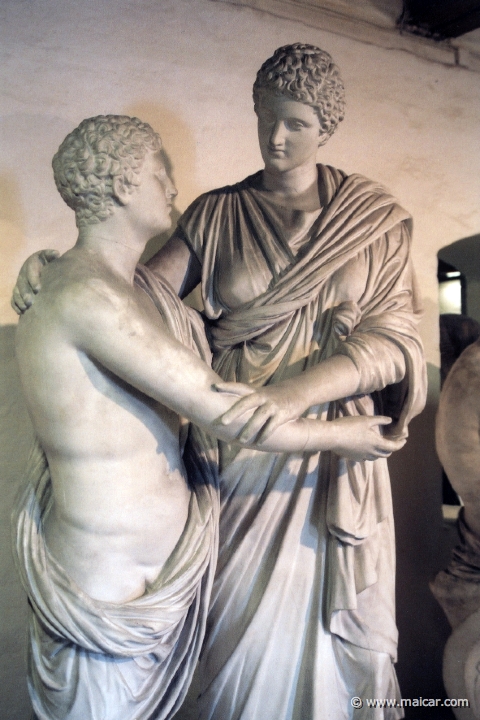
Orestes 2 was smuggled out of the country by his sister Electra 2. 8714: Orestes og Elektra fundet 1623. Menelaos, Romersk 1. årh. f./e. Kr. Rom, Museo Nazionale Romano (Royal Cast Collection, Copenhagen).
|
|
Rapes his own daughter
Being in such a plight, Thyestes 1 remembered the gods and visited the Oracle of Delphi, asking how he could have vengeance on his brother, and the oracle answered that he must lie with his daughter Pelopia 4 and beget a son who would avenge him. Later, when Thyestes 1 came to Sicyon he found that they were sacrificing to Athena by night, and fearing to profane the rites, he hid in a grove. Pelopia 4, who happened to lead the dancing groups during the sacrifice, slipped and stained her clothes with the blood of the slain victim. It was when she went to a nearby stream to wash off the blood, that Thyestes 1, coming out of the grove, raped his own daughter. This is how Aegisthus was conceived. However, Pelopia 4 drew his sword from the sheath during the ravishing, and when she returned to the temple she hid it under the statue of Athena, keeping it for the future.
Atreus in love with his niece
The next day, Thyestes 1 asked King Thesprotus 2 (probably the ruler of Sicyon at the time) to let him leave. But in the meantime, misery had come to Mycenae because of the crimes of Atreus, or so they saw it. The oracle was then consulted regarding the barrenness of the land, and it prescribed that Thyestes 1 should be recalled to the city. Atreus then, following the oracle's instructions, came to the court of King Thesprotus 2, where he hoped to find his brother. Thyestes 1 was away, but Atreus, having met Pelopia 4 in the court and believing that she was Thesprotus 2's daughter, asked the king that she be given to him in marriage.
Aegisthus brought to Mycenae
The king conceded his request, and Atreus, not knowing that Pelopia 4 was pregnant, brought the avenger Aegisthus, still in his mother's womb, to Mycenae. In the court of Atreus, the girl gave birth to Aegisthus and exposed him. Yet the babe was taken care by shepherds, who gave him to a goat to suckle, and survived. Having learned what had happened, and believing the child to be his own, Atreus ordered him to be found and, having brought him to his palace, raised him as his own son.
Family reunion
Years later, Atreus, still looking for his brother, sent his sons Agamemnon and Menelaus to inquire about him at Delphi. There they met, by chance, their uncle (who still asked the oracle about taking vengeance on his brother), and seized him, casting him into prison in Mycenae. Atreus then asked Aegisthus, whom he believed to be his third son, to kill Thyestes 1 in his confinement. Aegisthus came to the prison to carry out Atreus' request, but he appeared in front of the prisoner wearing the sword that Thyestes 1 had lost when he ravished his own daughter Pelopia 4. And when Thyestes 1 asked him where he had got it, Aegisthus replied that his mother Pelopia 4 had given it to him. They then summoned Pelopia 4, who said that she had stolen it from the unknown man who had raped her by night, the same who was Aegisthus' father. This is how father and son learned who they were, but Pelopia 4, realising who the father of her son was, snatched the sword and plunged it into her breast.
The Atrides
After this bizarre family reunion, Aegisthus bore the bloody sword to Atreus as an evidence of Thyestes 1's death. Later, while Atreus was sacrificing on the shore, Aegisthus slew him and restored his father to the throne, forcing the Atrides Agamemnon and Menelaus to go into exile to the court, some say, of King Polyphides 1 of Sicyon. Some years later however, the Atrides, supported by King Tyndareus of Sparta, returned and drove away Thyestes 1 to live in Cythera, an island off the southern coast of the Peloponnesus. The Atrides then married Tyndareus' daughters, Menelaus ruling in Sparta with Helen, and Agamemnon in Mycenae with Clytaemnestra. "Wonderful princesses," they perhaps thought when they married them, but both women turned out to be unfaithful, and more than that. Agamemnon and Menelaus were not like the sons of Oedipus, or like Atreus and Thyestes 1. They never let their differences to turn into permanent enmity. That is why, acting jointly, they were the most powerful rulers of their time. Nevertheless, their good fortune was disturbed when the seducer Paris, coming from abroad and going against all rules of hospitality, persuaded the Spartan queen to follow him to Troy, where he made her his wife.
War abroad
It is by reason of this abduction that the Trojan War broke out. For many princes and kings of Hellas had been among the SUITORS OF HELEN, and as such they had sworn The Oath of Tyndareus, on account of which, they were forced to comply with the demands of the Atrides and join the coalition that sailed against Troy, in order to demand, by persuasion or by force, the restoration of Helen and the Spartan property that the seducer Paris had stolen.
Aegisthus returns
The Trojans did not let themselves be persuaded to restore Helen, and for some reason or another, this was no short expedition but instead a prolonged war. Now, while Agamemnon was fighting at Troy, Aegisthus returned to Mycenae. He first took the minstrel whom Agamemnon had charged to guard his wife during his absence to a desert isle, leaving him to be the prey of birds, and then he persuaded Clytaemnestra to become his mistress.
Agamemnon's outrages
This was probably no difficult task; for she had come to hate Agamemnon, either because of the intrigues of Palamedes' father Nauplius 1, or because what happened to her sweet flower Iphigenia at Aulis, or because of all other violences that were inflicted on her by Agamemnon, particularly the murder of her first husband Tantalus 3, son of Thyestes 1. Besides, Agamemnon appeared in Mycenae accompanied by his new concubine Cassandra, whom he had taken as a prize after the sack of Troy, a circumstance which Clytaemnestra had learned in advance from Oeax, brother of Palamedes. In any case, when Agamemnon, after more than ten years of absence, returned victorious from Troy to Mycenae, he was not received by his wife, as they say, with crown or garland, but with a two-edged sword. Even less when she now counted on her new sweetheart:
"Aegisthus, loyal in heart to me as in days gone by. For he is no slight shield of confidence to me." (Clytaemnestra to the Elders. Aeschylus, Agamemnon 1436).
Agamemnon slain
|
|
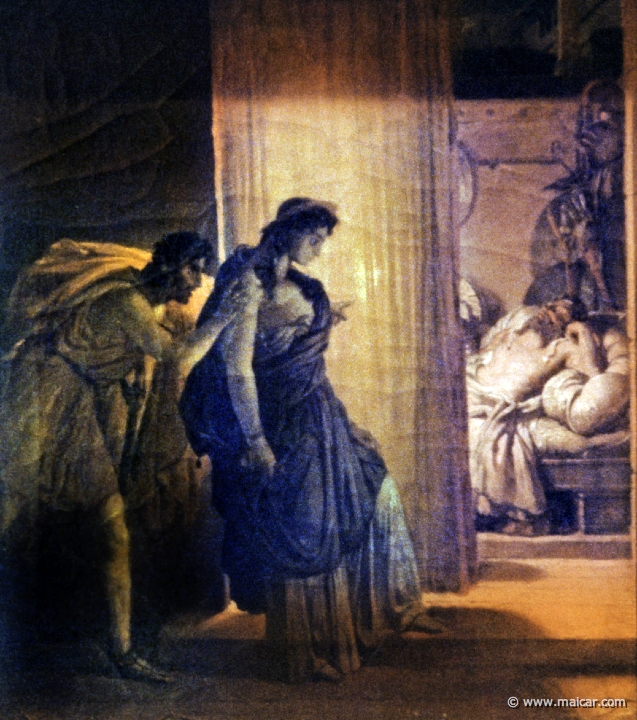
Aegisthus and Clytaemnestra, just about to slay Agamemnon. 4237: Pierre-Narcisse Guérin 1774-1833: Clytemnestre hésitant avant de frapper Agamemnon endormi. Musée de Picardie, Amiens.
|
|
There has been many accounts as to how Agamemnon died (see Agamemnon), whether it was Aegisthus or Clytaemnestra who dealt the murderous blow and in which circumstances, whether the victim was stepping from the bath, or while he was putting on a shirt, or when he was sacrificing, or in the course of a banquet. But whatever the weapon, the hand, or the circumstances, Agamemnon died the victim of a conspiracy staged by Aegisthus and Clytaemnestra.
Justification and Hope
Now, to assassinate the head of the state is no little matter. And since it cannot be hidden it must be explained and justified before the citizens so that, by dissipating suspicion, confidence in the new rulers might be restored. That is why Clytaemnestra, after the murder was known, addressed the Elders of the city, and recalled Agamemnon's many crimes and treacheries, arguing:
"... with death dealt him by the sword he has paid for what he first began." (Clytaemnestra to the Elders. Aeschylus, Agamemnon 1530).
… for some hope for the crimes of others to diminish their own. Yet, on learning what had happened the Elders said:
"The spoiler is despoiled, the slayer pays penalty. Yet, while Zeus remains on his throne, it remains true that to him who does it shall be done." (The Elders to Clytaemnestra. Aeschylus, Agamemnon 1560).
And as the Elders touched upon this law, feared by all who commit crimes, Clytaemnestra naturally hoped, now that she had achieved her aims, for her crime to be the last:
"A small part of the wealth is fully enough for me, if I may but rid these halls of the frenzy of mutual murder." (Clytaemnestra to The Elders. Aeschylus, Agamemnon 1575).
Wishful thinking
No doubt wishful thinking usually follows this foul deeds, and never leaves the hearts of the perpetrators:
"What we did had to be done. But should this trouble prove enough, we will accept it ..." (Clytaemnestra to Aegisthus. Aeschylus, Agamemnon 1575).
No doubt it would be a pleasure to humbly accept that gift. Yet, it usually proves to be impossible, and also here. For as the Elders predicted, Agamemnon's son would come to exact vengeance one day.
Death of Cassandra and her children
And after killing the king, Aegisthus and Clytaemnestra, or she alone, also killed his prisoner and concubine Cassandra. Cassandra's sons by Agamemnon, the babes Teledamus 1 and Pelops 2, were killed by Aegisthus. For Aegisthus this was a day of glory and joy, which had brought the death of the son of Atreus, who had driven him and his father out of the kingdom years ago. That is why he, when the Elders reproached him his crime, was on the point of letting his body-guard seize them, showing that he, who once had murdered Atreus and now Agamemnon, was the incontestable master of Mycenae. And in fact he remained in power for seven years, and some affirm that, when he was drunk, he used to jump on Agamemnon's grave, shouting insults against the dead king and his children.
Fear of killing and of not killing
It is well known that tyrants live in the company of fear. And so, dreading the descendants of Agamemnon, he planned to kill the king's son Orestes 2, who was still a child. Yet the little prince was smuggled out of the country either by his sister Electra 2, or by his nurse Arsinoe 4, or by an old slave who had previously been Agamemnon's tutor. It is said that he also wished to kill Electra 2, who opposed him and her mother, but that he was prevented by Clytaemnestra, who feared even more the hatred that such a deed would arouse.
Aegisthus' death
After seven years of reign, Agamemnon's son Orestes 2, following the instructions he received in the Oracle at Delphi, returned to Mycenae, accompanied by his friend Pylades, and avenged his father by killing both Aegisthus and his own mother. Some say that the royal guard, having recognized the son of Agamemnon, did not intervene but instead applauded the usurper's murderer. And it is told that when Aegisthus was trapped, Orestes 2 led him to the place in the palace where Aegisthus had murdered Agamemnon, killing him on that same spot. For revenge seeks to imitate the gestures of outrage and to return to the location where the first affront occurred, turning both gestures and location into a meaningful symbol from which it derives its deepest pleasure. Yet the price of such pleasure is deep grief, without which vengeance cannot be nourished.
Aletes 1 succeeds Aegisthus
Here again some say that Clytaemnestra was killed before Aegisthus, and others assert the opposite. But when they died, the throne did not revert immediately to Orestes 2, who went mad after committing matricide. Instead, when false news of his death abroad reached Mycenae, the throne was seized by Aegisthus' son Aletes 1, who only later was dethroned and killed by Orestes 2. Such was the fate of Aegisthus, to slay and to be slain. He was, they say, warned by the gods:
"Look you now, how ready mortals are to blame the gods. It is from us, they say, that evils come, but they even of themselves, through their own blind folly, have sorrows beyond that which is ordained. Even as now Aegisthus, beyond that which was ordained, took to himself the wedded wife of the son of Atreus, and slew him on his return, though well he knew of sheer destruction, seeing that we spake to him before, sending Hermes, the keen-sighted Argeiphontes, that he should neither slay the man nor woo his wife; for from Orestes shall come vengeance for the son of Atreus when once he has come to manhood and longs for his own land. So Hermes spoke, but for all his good intent he prevailed not upon the heart of Aegisthus; and now he has paid the full price of all." (Zeus to the gods. Homer, Odyssey 1.34ff.).
Aegisthus, along with his mistress, were buried outside the city wall, being thought unworthy of a place within it.
|
| Family |
|
|
|
|
|
|
|
-
- Thyestes 1 was son of Pelops 1, son of Tantalus 1, son of Zeus and Pluto 3, daughter of Himas. He had a permanent feud with his brother Atreus concerning the throne of Mycenae.
- Pelopia 4 was daughter of Thyestes 1. He killed herself [see main text above].
|
|
|
|
|
|
|
|
It is sometimes said that it was Erigone 1 who brought Orestes 2 to trial for the death of her parents. Nevertheless she consorted with the same Orestes 2 and had a child Penthilus 1 by him. But some say that Erigone 1 was so grieved because of Orestes 2's acquittal, that she hanged herself.
Penthilus 1 led the Aeolian colonisation, which preceded the Ionian by four generations. He advanced as far as Thrace sixty years after the Trojan War, about the time of the return of the HERACLIDES to the Peloponnesus. Penthilus 1 had a son Echelas, father of Gras, who colonized Aeolia in Asia Minor. Penthilus 1 had another son Damasius, father of Agorius. This Agorius was brought by Oxylus 2 from Helice in Achaea to Elis as co-founder, because he considered him to be the descendant of Pelops 1 that, in agreement with an oracle, he was searching for [for Oxylus 2 see HERACLIDES].
Aletes 1 seized power in Mycenae when he heard the false rumour that Orestes 2 and Pylades had been sacrificed in Tauris. He was killed by Orestes 2, on the latter's final return to Mycenae.
|
|
|
|
|
|
|
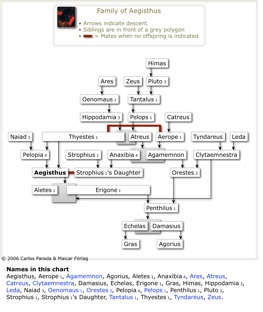
Genealogical Charts
Names in this chart: Aegisthus, Aerope 1, Agamemnon, Agorius, Aletes 1, Anaxibia 4, Ares, Atreus, Catreus, Clytaemnestra, Damasius, Echelas, Erigone 1, Gras, Himas, Hippodamia 3, Leda, Naiad 3, Oenomaus 1, Orestes 2, Pelopia 4, Pelops 1, Penthilus 1, Pluto 3, Strophius 1, Strophius 1's Daughter, Tantalus 1, Thyestes 1, Tyndareus, Zeus.
|
|
|
| Related sections |
Pelopides, Agamemnon, Clytaemnestra, Orestes 2, Electra 2 |
|
|
Sources
Abbreviations |
Aes.Aga.1584; Aes.LB.passim; Apd.Ep.6.9, 6.25; Dictys 6.4; Eur.Ele.10; Hom.Od.1.35, 1.43, 1.300, 3.194, 3.235ff., 4.519ff., 11.389, 24.23, 24.98; Hyg.Fab.87, 88, 122; Pau.2.16.6-7, 2.18.2; Pin.Pyth.11.37; Soph.Ele.passim.
|
|
|