|
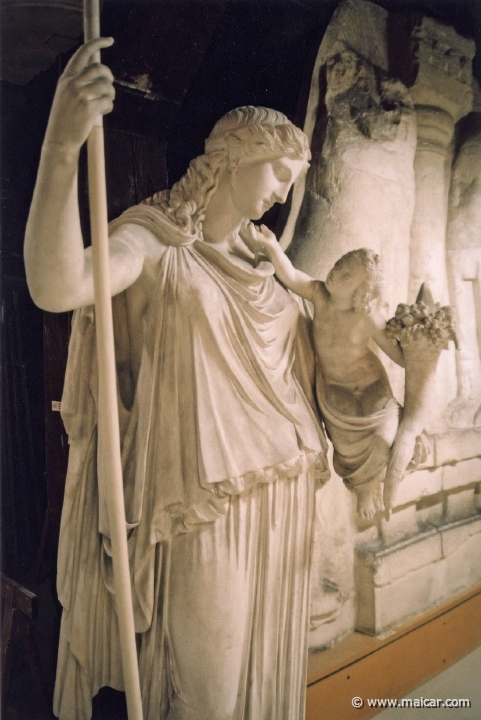
Eirene 1 is Peace.
|
|
Irene 1 es Paz
|
|
|
|
|
Daughter of Themis
The Titaness Themis is
said to have laid down all laws and ordinances
established by custom; this wisdom, some believe,
she receives from Zeus while she sits leaning towards him in Olympus. From the union of these two, Eirene 1 (Peace), who is one of the Seasons or Hours, was born, having in her the heavenly qualities of what is calm, quiet and still. That is why Eirene 1, whom Zeus loves, provides always
with gentleness.
|
Hija de Temis
Se dice que la Titánide Temis implementó todas las leyes y normas que establece la costumbre; esta sabiduría, creen algunos, la recibe de Zeus cuando sentada se inclina hacia él en el Olimpo. De la unión de estos dos, nació Irene 1 (Paz)una de las Horas o Estaciones quien posee las celestiales cualidades de lo que es calmo, tranquilo y sereno. Por eso Irene 1, amada de Zeus, siempre reparte sus dones con dulzura.
|
|
Great blessing
Since she attends the works of mortals, Eirene 1 has been called the fairest of the goddesses; and those who live according to her instructions dwell in ease, seeing their cities flourish, enjoying prosperity, and being loved by the gods. For Peace is regarded, along with her sisters Justice and Order
(Eunomia), as the secure foundation of cities, and
as the one who opens all gates leading to
prosperity and anything derived from it. That is
why artists has shown her as the nurse of
Wealth, and poets have
called her the nurse of
Demeter, the
MUSES' dearest friend, the
great blessing of mankind, and the foe of all
sorrows.
|
Gran bendición
En razón de que preside las obras de los mortales, Irene 1 ha sido llamada la más hermosa de las diosas; y quienes viven de acuerdo con sus normas llevan una existencia holgada, viendo florecer sus ciudades, y disfrutando de la prosperidad y el amor de los dioses. Ello es así porque a Paz se la considera, junto con sus hermanas Justicia (Dike) y Orden (Eunomia) como el fundamento firme de los pueblos, siendo la que se encarga de abrir los portales que conducen a la prosperidad y a todo lo que de ésta se deriva. Por esa razón los artistas la han representado como la nodriza de Riqueza, y los poetas la han llamado nodriza de Deméter, amiga preferida de las MUSAS, gran bendición de la humanidad, y enemiga de todas las tristezas.
|
|
Lessons of
Necessity
Yet, to those undeveloped in their tastes, she
might appear as a boring goddess, deprived of every
kind of excitement, and closing the way to
Fame and even greater
prosperity. And following these bizarre ideas, they
may cast away all her blessings, and after
banishing her, embark in war or other forms of
wicked violence. But when Peace, who is brought by
Love, leaves, and
Zeus decrees war against
the violent, they, falling under the compelling
power of Necessity
(Ananke), lose initiative
in their own lives. And being forgotten by the
MUSES, who depart with
their friend, they must lead a life in ugliness.
And he who takes his lessons from Peace, both
without and within, is free from toil and grief,
whereas those who banish her learn from sorrows and
Necessity, who knows no
law.
|
Lecciones de la Necesidad
Sin embargo, en la manera de ver de quienes no han pulido mucho sus gustos, Irene 1 podría parecer más tediosa que diosa, pues la ven desprovista de toda clase de emoción fuerte, y capaz de bloquear el camino de la Fama y de una prosperidad aún mayor. Y siguiendo la huella de estas extrañas ideas, podría suceder que se deshicieran de todas sus bendiciones y, enviándola al exilio, se embarcaran en guerras u otras formas de violencia malvada. Pero cuando Pazque es introducida por Amorse aleja, Zeus declara la guerra contra los violentos, quienes caen bajo el fuerte poder de Necesidad (Ananque), perdiendo toda iniciativa en sus propias vidas. Siendo así abandonados por las MUSASquienes se retiran en compañía de su amigadeben disponerse a vivir sumidos en la fealdad. Así el que acepta las lecciones de Paz, tanto en lo externo como en lo interno, se ve liberado de todo esfuerzo y pena, pero quienes la persiguen y acosan se ven forzados a recibir las lecciones que imparten el infortunio y la Necesidad, que desconoce toda ley.
|
|
Upside-down world, and cocks
And when a whole land casts Peace away it founds
itself in an upside-down world:
"In peace sons
bury their fathers, in war fathers bury their
sons." (Herodotus, History 1.87.4).
… with different signals and sounds:
"In peace the
sleeper is waked not by the trumpet, but by the
cock." (Plutarch, Parallel
Lives Nicias 9.5).
… although it is also said that the cocks are those who:
"… arouse us for battle by inducing an eagerness for valour." (Plutarch, Moralia 1049a).
But regardless of the role of the cocks during
peace-time and war-time, some have noticed that
even though it is the young who are buried in war,
it is nevertheless they who want war, whereas the
elderly, tamed by Old Age,
usually prefer Peace. For
Youth, they believe,
relying mainly on strength, easily gives herself to
violent dealings.
|
El mundo al revés y los gallos
Y cuando un país entero le da la espalda
a la paz, descubre de pronto un mundo al
revés:
"En la paz los
hijos entierran a sus padres, en la guerra los
padres entierran a sus hijos." (Heródoto 1.87.4).
…con diferentes sonidos y señales:
"En tiempo de
paz, el que duerme es despertado no por la trompeta
sino por el gallo." (Plutarco, Nicias 9.5).
…aunque de los gallos también se ha dicho que:
"… nos dan ánimo en la batalla, inspirándonos el ansia de valor." (Plutarco, Moralia 1049a).
Pero cualquiera que fuera el papel de los gallos
en tiempos de paz o de guerra, se ha
señalado que pese a que son los
jóvenes quienes se entierran en la guerra,
son sin embargo ellos mismos los primeros a
desearla, mientras que los mayoresdomados ya
por la Vejezprefieren la paz, juzgando que la
juventud, por confiar principalmente en sus
fuerzas, fácilmente se entrega a actos de
violencia.
|
|
Peace disturbed
War itself may be called necessary or
inevitable, but it is seldom called desirable. That
is why those who, right or wrong, by necessity or
by ambition, advocate for war, proclaim at the same
time that war must be, not for its own sake but for
the sake of Peace, just as business is for the sake
of leisure, or necessary things for the sake of
higher things.
Everyone knows that war is followed by Peace and
yet, it has been remarked, there are such states
that survive war but perish in peace-time or fall
into disorder on account of the inability of their
citizens to properly employ leisure, which is to
business as Peace is to war. For peaceful leisure,
they add, which is the enjoyment of prosperity,
tend to make them insolent. And since insolence
contributes to disturb Peace, it has been deemed
desirable and of the utmost importance, that those
who enjoy prosperity and are therefore more
influential, be self-restrained, compassionate and
just:
"The evil
workings of Envy are warded off, if a man who
attains the summit and dwells in peace escapes
dread arrogance." (Pindar, Pythian
Odes 11.55).
For Peace cannot be without
Justice, and none of them will remain if disorder prevails. That is why the three sisters Eirene 1, Dike and Eunomia are often
mentioned in the same breath; and when one leaves,
the others follow.
|
La paz perturbada
La guerra puede ser calificada de necesaria o
inevitable, pero rara vez se la llama deseable. Y
quienes ansían la guerraya con
razón o sin ella, ya por necesidad o por
ambiciónproclaman que la guerra debe
declararse, no como un fin en sí mismo, sino
por defender la paz. Se piensa de manera similar
cuando se dice que los negocios encuentran su
razón de ser en el ocio, o cuando se afirma
que las cosas necesarias existen en razón de
otras más elevadas.
Todos saben que a la guerra sucede la paz y sin
embargo hay quien ha observado que existen estados
que, aunque capaces de sobrevivir la guerra,
perecen en tiempo de paz o se ven sumidos en un
profundo desorden a causa de la falta de habilidad
de sus ciudadanos para emplear de manera adecuada
el tiempo de ocio, el cual es a los negocios como
la paz es a la guerra. Se añade, por
ejemplo, que el ocio
pacíficoequivalente al disfrute de la
prosperidadtiende a que los hombres se
vuelvan insolentes. Y como la insolencia perturba
la paz, se ha juzgado deseable y de la mayor
importancia, que quienes disfrutan de la
prosperidad (siendo por esa razón más
influyentes), sean moderados, justos y proclives a
sentir compasión:
"Las
maquinaciones malvadas de la Envidia pueden
contenerse si el hombre que alcanza la cumbre y
vive en la prosperidad escapara a la terrible
arrogancia." (Píndaro, Píticas 11.55).
Pues no puede haber Paz sin Justicia, y ninguna de ellas permanecería si el desorden prevaleciera. Por ello las tres hermanasIrene 1, Dike y Eunomiase mencionan frecuentemente en el mismo aliento; y cuando una se va las otras la siguen.
|
|
Undenied power
These three sisters are venerated practically by
all. For it is never declared that it is a good
thing to scorn Justice,
destroy Peace, or live in disorder.
Yet some apparently believe that the goddesses
can be separately worshipped, since it is heard,
for example, that Peace must be banished for the
sake of Justice, or that
Justice must be suspended
in order to preserve Order. This is an illusion,
and a most peculiar way of looking at things, since
the three sisters are inseparable. And that is why
those who in practical life separate them, sensing
the abnormality of their own way of thinking,
present that separation as a provisional or
unwanted state of affairs, yet necessary in order
to better serve the three goddesses at a later
time.
For no matter how much someone goes in practical
life against these goddesses, he will still claim
to serve and worship them, since the immense power
of Peace and her sisters, prevents anybody from
denying them, or even talking against them.
|
Poder innegable
Estas tres hermanas son veneradas
prácticamente por todos, pues nadie se
atreve a declarar abiertamente que es algo
beneficioso el despreciar la Justicia, destruir la
Paz, o vivir en el desorden.
Sin embargo algunos creen que estas diosas
pueden ser veneradas cada cual por su lado. Pues se
oye, por ejemplo, que la Paz debe desterrarse a fin
de obtener Justicia, o que la Justicia debe ser
suspendida para preservar el Orden. Esto es, claro
está, una ilusión y una manera muy
peculiar de ver las cosas, puesto que las tres
hermanas son inseparables. Y quienes las separan en
la vida práctica argumentan que tal
separación es necesaria para más
adelante poder servir mejor a las tres deidades;
pero ellos mismossintiendo la anormalidad de
sy propia manera de pensarpresentan dicha
separación como una circunstancia indeseable
y provisoria.
No importa en realidad en qué medida se
vaya contra ellas en la vida práctica:
siempre se declarará que lo que se hace es
para mejor servirlas y venerarlas, pues el poder de
la Paz y sus hermanas es tan inmenso que nadie
puede negarlas o siquiera hablar mal de ellas.
|
|
Deities called "Abstractions"
Yet some have affirmed that these are not
goddesses, and they prefer to call them
'abstractions', saying that these are not personal
deities, but properties inherent in ourselves, or
objects of our desire. Their view, however, has no
practical relevance, and leads no farther; for they
are nevertheless bound to serve and worship the
abstractions, as if they were deities. And it is as
difficult to investigate the nature of these
abstractions as it is to investigate the nature of
the gods.
|
Deidades llamadas
«Abstracciones»
No obstante, hay quienes han afirmado que estas
no son diosas, y prefieren llamarlas
'abstracciones', argumentando que no se trata de
deidades personales, sino de objetos de nuestro
deseo o propiedades inherentes a nuestra manera de
pensar. Este punto de vista, sin embargo, no tiene
relevancia práctica ni conduce a ninguna
parte, dado que los mismos que eso afirman se ven
forzados a servir y venerar esas mismas
abstracciones como si fueran deidades. Y es tan
difícil investigar la naturaleza de las
abstracciones como lo es el investigar la
naturaleza de los dioses.
|
|
Another with identical name
Eirene 2 was a woman of Calaurea, the island (Poros) in the entrance of the Saronic Gulf off the Argolid coast. She was daughter of Poseidon and
Melantheia, daughter of the river god Alpheus.
|
Otra con nombre idéntico
Irene 2 era una mujer de Calaurea, la isla (Poros) en la entrada del Golfo de Sarónica, que forma la costa de la Argólide. Era hija de Poseidón y de Melantía, hija del dios del río Alfeo.
|