|
|
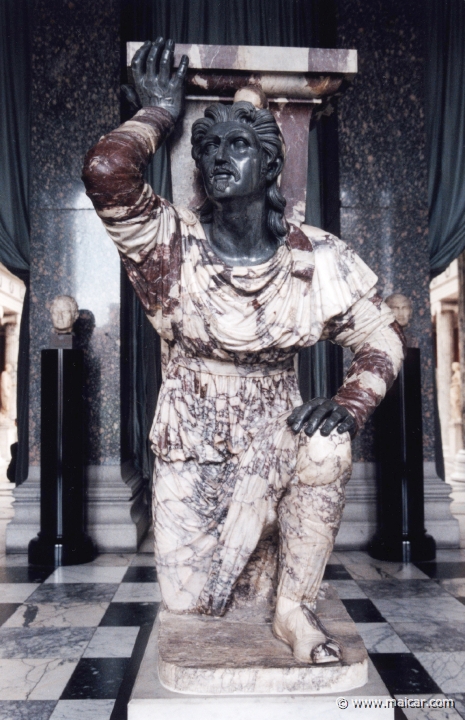
Man from Persia, the country which destroyed Croesus' Lydian kingdom. 5103: Kneeling Persian. Roman after Hellenistic original 2C AD. Ny Carlsberg Glyptotek, Copenhagen.
|
|
|
"As for Solon's interview with Croesus, some think to prove by chronology that it is fictitious. But when a story is so famous and so well-attested, and, what is more to the point, when it comports so well with the character of Solon, and is so worthy of his magnanimity and wisdom, I do not propose to reject it out of deference to any chronological canons, so called, which thousands are to this day revising, without being able to bring their contradictions into any general agreement." (Plutarch, Parallel Lives Solon 27.1).
"… even I cannot eradicate from myself that passion for wealth which the gods have put into the human soul and by which they have made us all poor alike, but I, too, am as insatiate of wealth as other people are. However, I think I am different from most people, in that others, when they have acquired more than a sufficiency, bury some of their treasure and allow some to decay, and some they weary themselves with counting, measuring, weighing, airing, and watching; and though they have so much at home, they never eat more than they can hold, for they would burst if they did, and they never wear more than they can carry, for they would be suffocated if they did; they only find their superfluous treasure a burden." (Cyrus to Croesus. Xenophon, Cyropaedia 8.2.20-21).
|
|
King Croesus of Lydia became proverbial for his wealth and the prosperity of his kingdom. His life and deeds crossed the border between Myth and History. And Croesus himself, having been double-crossed by the oracles, crossed with an army the river separating his country from that of the Persians, causing thereby his own ruin.
King of Lydia
History, and not the myths, affirms that Croesus reigned, as last king of Lydia, from 560 to 546 BC, over all peoples and cities between the Aegean coast of Asia Minor in the west and the river Halys in the East, having as his capital the city of Sardis, which is between Mount Tmolus and the river Hermos.
Kings of Sardis
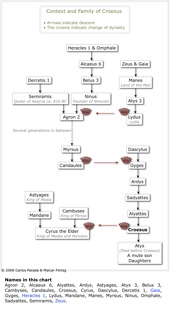
Sardis is said to have been founded by Sardo, son of Sthenelus 7, otherwise unknown. But the country Lydia, previously known as land of the Meii, was called after King Lydus, son either of Heracles 1, or of Atys 3 and Callithea, daughter of Choraeus. The first king of Lydia was Manes, son of Zeus and Gaia. He had, by the Oceanid Callirrhoe 1, two sons: Atys 3 and Cotys 2. However, Atys 3 is also said to have been the son of Cotys 2 and Halie 2, daughter of Tyllus, an autochthon. Whatever the case may be, it was Atys 3, a descendant of Heracles 1 and Omphale, who succeeded his father Manes on the throne.
Descendants of Heracles 1
When the throne had thus passed from Manes to Atys 3 and from Atys 3 to Lydus, it came into the hands of Agron 2, who could or not be the same that History remembers as Adadnirari III. Agron 2 was the son of the Assyrian queen Semiramis, who lived about 810 BC and turned, at her death, into a white dove, a quite natural event, if one remembers that her mother Dercetis 1, a Babylonian, had previously turned into a fish. Semiramis, who ended her life by committing suicide, was married to Ninus, whom she murdered. Ninus, credited with the foundation of Nineveh, the capital of the Assyrians, was known as son of Belus 3, son of Alcaeus 6, son of Heracles 1 and Omphale, or of Heracles 1 and a female slave of King Iardanus, otherwise called father of Omphale. In addition, some suggest that this Heracles was not Heracles 1, but instead an Asiatic god or man.
The naked queen
In any case, the line of Agron 2 ruled in Sardis down to Candaules, who lost his throne for being limitless obsessed with his wife's beauty. For it happened that Candaules, being unable to control his idée fixe, and knowing that men trust their ears less than their eyes, not only told his favorite bodyguard Gyges about her beauty, but also wished him to watch the queen naked from a hiding place. At first, Gyges refused, entreating his master not to ask lawless acts of him. But when the king insisted, he had to consent, and was brought by Candaules himself to the queen's chamber, at bed time. The queen laid her garments aside, and Gyges saw her naked. But on leaving the room, she detected him and understood what her husband had contrived. At the moment she said nothing, but having decided to punish Candaules—for as they say it was a great shame among the Lydians to be seen naked—she called Gyges the next day, giving him the following choice: either to kill Candaules and take her as wife along with the throne, or himself be killed. Gyges entreated her not to impose on him such a choice, but he could not move her more than he had moved Candaules when the whole affair started. This is why Gyges plotted against his master, and following the queen's instructions, he came out from the same hiding place, and slew the sleeping king with the dagger that she had given him for that purpose.
Vengeance in the fifth generation
The regicide caused a revolt, but Gyges and the Lydians agreed that if the Oracle of Delphi should confirm him in power, then he should reign. And since the oracle did so ordain, the descendants of Heracles 1 lost the sovereignty, and Gyges became king. Yet some have said that the family of Croesus also descended from Heracles 1 and Omphale through their son Agelaus 1, who could or not be the same as Lamus 1, or Hyllus 3. The oracle also said that vengeance would fall upon Gyges' posterity in the fifth generation, which proved to be Croesus', for Croesus is son of Alyattes, son of Sadyattes, son of Ardys, son of Gyges (himself son of Dascylus). But at the time, Gyges had all reasons to be grateful to the oracle, and that is why he is reported to have been the first foreigner, after King Midas, to send many valuable offerings in silver and gold to Delphi.
Gyges and successors
Gyges kept great devotion for the woman who had been his mistress and whom he won as wife through murder, letting her rule the country. And when she died, he honoured her with a monument high enough as to be seen from the region about Mount Tmolus and many parts of Lydia. Gyges, who reigned thirty-eight years, took the city of Colophon and started a long war against Miletus that was inherited by his successors, until peace was agreed between Thrasybulus, ruler of Miletus, and Gyges' great grandson Alyattes, contemporary of King Periander, under whose reign Arion 2 was rescued by a dolphin. Alyattes is said to have married twice, having children by both women, one from Caria and the second from Ionia. It is said that the latter plotted against her stepson Croesus, giving poison to the woman who baked the bread, and telling her to knead it into it. But the baker warned Croesus, and served the bread to the stepmother's children instead. It is for this reason that later, when Croesus became a wealthy king, he let a golden statue of the baker be made, and offered it at Delphi.
King Croesus
When Alyattes died, his thirty-five years old son by the Carian woman—Croesus—came to the throne, probably in 560 BC, having destroyed a faction that conspired to win the throne for his half-brother Pantaleon, son of Alyattes by the Ionian mother. When Croesus was victorious, he confiscated the estate of his enemy and put him to death by drawing him across a carding-comb. It was under Croesus' rule that the Greeks living in the Asiatic mainland were made tributary for the first time, and that all other nations west of the river Halys were subdued, becoming his subjects. This successful expansion resulted in great wealth, and since wealth, along with the power that derives from it, attracts many, including the wise, Sardis became the magnet of its time, being visited, as they say, by many teachers from Hellas. For teachers go preferably where their wages can be paid, and not necessarily where their knowledge is more needed. And there they met Croesus, the great potentate of his time, who
"… was decked out with everything in the way of precious stones, dyed raiment, and wrought gold that men deem remarkable, or extravagant, or enviable, in order that he might present a most august and gorgeous spectacle." (Plutarch, Parallel Lives Solon 27.2).
Solon visits Croesus
Among the wise men who visited Sardis, they say, was the Athenian statesman and poet Solon (c. 640 – c. 560 BC), whom Croesus entertained in his palace, showing him the treasures, greatness and prosperity of his country; for besides being spent, wealth may also be used to cause admiration. After having thus acquainted his visitor with the country's riches, Croesus, who supposed himself to be the most blessed man, asked Solon—who was renowned for his wisdom and for having seen the world and traveled far while seeking knowledge—if he had ever seen a man more happy than he. Solon, however, gave the first prize of happiness to an inconspicuous Athenian, and when asked again, he gave the second to a couple of Argive brothers, which caused Croesus to exclaim:
"… Is our prosperity, then, held by you so worthless that you match us not even with common men." (Croesus to Solon. Herodotus, History 1.32).
Solon replied that the life of man was entirely chance, being completely unknown what any day might bring. And then, speaking of his host, he added:
"To me you seem to be very rich and to be king of many people, but I cannot answer your question before I learn that you ended your life well. The very rich man is not more fortunate than the man who has only his daily needs, unless he chances to end his life with all well. Many very rich men are unfortunate, many of moderate means are lucky. The man who is very rich but unfortunate surpasses the lucky man in only two ways, while the lucky surpasses the rich but unfortunate in many. The rich man is more capable of fulfilling his appetites and of bearing a great disaster that falls upon him, and it is in these ways that he surpasses the other. The lucky man is not so able to support disaster or appetite as is the rich man, but his luck keeps these things away from him, and he is free from deformity and disease, has no experience of evils, and has fine children and good looks. If besides all this he ends his life well, then he is the one whom you seek, the one worthy to be called fortunate. But refrain from calling him fortunate before he dies; call him lucky … Whoever passes through life with the most and then dies agreeably is the one who, in my opinion…deserves to bear this name. It is necessary to see how the end of every affair turns out, for heaven promises fortune to many people and then utterly ruins them." (Solon to Croesus. Herodotus, History 1.32).
Wisdom, Power and Tact
This was Solon's view on the subject of happiness. But since he seemed to disregard prosperity, concentrating mainly in the end of every matter, Croesus concluded that his visitor was a man of no account, and sent him away accordingly. Aesop the fabulist, who flourished in the same period of time as the Seven Sages (among which Solon was counted), remarked once:
"These men do not know how to act in the company of a ruler; for a man should associate with rulers either as little as possible, or with the best grace possible." (Diodorus, The Library of History 9.28.1ff.).
But for all his tact, Aesop could not escape being killed by the Delphians on a false charge of sacrilege, when he had come to make an offering in Croesus' name. Others say that Aesop, knowing that Croesus had not treated Solon kindly, brought up the subject with the Athenian statesman:
Aesop: "O Solon, our converse with kings should be either as rare, or as pleasing as is possible."
Solon: "No, indeed, but either as rare or as beneficial as is possible." (Plutarch, Parallel Lives Solon 28.1).
Still others seem to have deemed these encounters unavoidable, probably because those who have wisdom usually lack wealth, and those who have wealth usually lack wisdom:
"It is natural for wisdom and great power to come together, and they are for ever pursuing and seeking each other and consorting together." (Plato, Letters 310e).
Croesus' children
Croesus had children, apparently both sons and daughters. One of the sons, being both deaf and dumb, meant very little for Croesus. But the one he loved was accidentally killed while hunting by a Phrygian whom Croesus had received in his own house after cleansing him for the death of his brother, whom he had slain, also accidentally. The Phrygian declared that he did not deserve to live, but Croesus, who at first was angry at him, decided not to punish him, blaming his own fortune rather than the intent of the young Phrygian. Nevertheless, the Phrygian, having killed two men by accident, went to the tomb of Croesus' son, and slew himself upon it.
Croesus would destroy a great empire
It was a couple of years after the death of his beloved son that Croesus started to worry about the growth of the power of the Persians, conceiving a preemptive war against them. With this purpose in mind, he consulted and tested the credibility of several oracles, being more satisfied with the answers provided by the one at Delphi, and the oracle of Amphiaraus at Thebes. And having offered many gifts to both, he sent Lydian envoys to inquire the following:
"Shall Croesus send an army against the Persians: and shall he take to himself any allied host?" (Herodotus, History 1.53).
Both oracles, they say, gave the same answer, namely that if he should send an army against the Persians he would destroy a great empire. And they also advised him to make alliance with the mightiest of powers in Hellas. Pleased with these answers (as well as with the previous tests), he sent splendid gifts to Delphi, which in turn pleased the Delphians so much that they granted him and the Lydians the right of first consulting the oracle, freedom from charges, the best seats at festivals, and life-long right of Delphian citizenship to whoever should wish. And following the oracle, Croesus sent messengers to Sparta, and made an alliance with the Lacedaemonians.
A mule king
Having obtained such privileges at Delphi, Croesus made yet an inquiry, asking whether his sovereignty should last long. And the answer of the Pythia was:
"Lydian, beware of the day when a mule is lord of the Medians." (Herodotus, History 1.55).
This answer also pleased Croesus, for he did not deem likely that a mule would ever be king of the Medians instead of a man.
Sandanis' counsel
Now, war is always a dangerous business to be feared and respected, no matter which side strength and surprise and other factors seem to favor, for unexpected turns, sometimes having far reaching effects, can never be dismissed. And since what is risked through war should be carefully compared with the eventual gains of a successful campaign, the Lydian wise man Sandanis counseled Croesus in the following manner, when he was preparing to march against the Persians:
"O King, you are making ready to march against men who wear trousers of leather and their other garments of the same, and who eat not what they desire but what they have; for their land is stony. Further they use no wine, but are water drinkers, nor have they figs to eat, nor aught else that is good. Now if you conquer them, of what will you deprive them, seeing that they have nothing? But if on the other hand you are conquered, then see how many good things you will lose …" (Sandanis to Croesus. Herodotus, History 1.71).
Fears growing power
Yet Croesus, seeing how Cyrus had gained control over the land of the Medes, making himself the master of their vast territory, and thereby bringing the Persians to the eastern bank of the river Halys, chose to disregard Sandanis' counsel, and put his forces in motion. It is told that Croesus, among other measures, dispatched an agent—Eurybatus of Ephesus—with money to recruit Greek mercenaries, but Eurybatus, they say, went over to the enemy, revealing to Cyrus his master's plans.
Crosses the border
Having led his army to the border, Croesus crossed the river Halys at a place not far from Sinope in the coast of the Black Sea, either through bridges, or being helped by the celebrated sage Thales of Miletus, who by digging a semicircular trench, turned the course of the river, causing part of its stream to flow in the trench to the rear of the Lydian camp, and passing it, return to its former bed. Croesus began his campaign laying waste farms, enslaving cities, and driving the inhabitants from their homes. But then King Cyrus (who is the elder Cyrus, the son of Cambyses), a man fortunate in war, and renowned for being a wise ruler, came to meet the invader, gathering more men as he marched and campaigned against many foes in Asia. It is told that before the battle Cyrus sent messengers to Croesus, saying that he would forgive him and appoint him satrap of Lydia if Croesus presented himself at the Persian court acknowledging Cyrus as his master. But Croesus answered that Cyrus should submit instead, given that until then the Persians had been under Median rule.
Return to Sardis
The Lydian army, supported among others by Egyptian units, attempted to surround the Persians, but failed. Some have said that the battle ended in stalemate, and others that the Lydians were defeated. In any case Croesus has been reported to have judged prudent to march away to Sardis. Having returned to his capital, Croesus summoned his allies, among which the Lacedaemonians, to join him at Sardis in five months time for a spring campaign against the Persians, and in the meantime, some say, he disbanded many of his Lydian units, believing that after such equal encounter the Persian king would not dare to march against his capital.
Portents reported
At this moment, portents were reported to have been witnessed in the outer part of Sardis, such as horses devouring snakes, which seers, with their usual sharp-wittedness, interpreted as a sign of invaders conquering the country. For the snakes, they claimed, represent the children of the earth, and the horses stand for the enemy and the foreigner. They were right, for Cyrus, having learned of the state of the Lydian army, and caring little for the previous stalemate, marched with all speed against Sardis without giving Croesus any chance to assemble his forces again.
Sardis beleaguered
The Lydian king, however, led the remains of his army to the plain that is before the city, arraying his skilled cavalry to meet the invaders. But Cyrus, they say, assembled all the camels he normally used for transportation of food and baggage, setting men upon them equipped like cavalrymen, and behind them he put his infantry, and behind the infantry he put his horsemen. And in this manner, they tell, when the Lydian horses saw the Persian camels, they were frightened, and the battle being thereby lost, Sardis was beleaguered.
Sardis taken
At first, the Persian army made unsuccessful assaults. But when fourteen days had passed, the Persians discovered a certain part of the citadel neglected by the defence because of its height and difficult access, and climbing up on this side, which faces towards Mount Tmolus, the Persians succeeded in taking the city. This fortunate discovery was made by a Persian soldier called Hyroeades, who during the days of siege, observed a Lydian defender descending by this part of the citadel in order to fetch a helmet that had fallen down. It has also been told that, in former times—when King Meles ruled Sardis—his concubine borne him a lion. It was then declared that if the lion were carried round the walls, Sardis would never be taken. Meles, they say, did as it was prophesied and carried the beast round the walls. However, he excepted that part of the acropolis which he judged impossible to attack on account of its height. And it was precisely here that Hyroeades and the rest of the Persians climbed up, taking the city.
Pyre for Croesus (I)
Croesus, some assert, had prepared himself for this day of utter defeat. And being determined to escape slavery he had built a pyre, which he mounted together with his wife and daughters, when the Persians were about to sack the city. The women were weeping inconsolably as he, while reproaching Apollo's ingratitude, ordered a slave to kindle the pyre. It was then that Zeus sent the rain-cloud that quenched the flames, and Apollo came to bring Croesus and his family to live among the Hyperboreans …
"… since of all mortals he sent the greatest gifts to holy Pytho." (Bacchylides, Odes 3.64).
… and as if it were suspected that some could find this impossible, it is added:
"Nothing is unbelievable which is brought about by the gods' ambition." (Bacchylides, Odes 3.57).
Mute speaks
But others tell otherwise, affirming that during the sack of Sardis a Persian soldier came at Croesus with intent of killing him, not because he wished to disobey King Cyrus, who had given orders to capture Croesus alive, but because—as it often happens—he did not know who Croesus was. And when Croesus' dumb son, who at the moment was with his father, saw the Persian soldier coming, he, who had never uttered a single word, broke into speech and exclaimed:
"Man, do not kill Croesus!" (Croesus' son to the Persian soldier. Herodotus, History 1.85).
In this way another oracle was fulfilled which had prophesied that Croesus' son would speak some unfortunate day:
"O you of Lydian stock, over many king. You great fool Croesus: never wish to hear within your halls the much-desired sound of your son speaking. Better far for you that he remain apart; for the first words he speaks shall be upon a luckless day." (Diodorus, The Library of History 9.33.2).
The Persian soldier then, obeying his king, spared the life of Croesus, who was made a prisoner after fourteen years of reign and fourteen days of siege. This is how the oracle was fulfilled, for by attacking the Persians the king of Lydia destroyed a great empire, as it had been foretold.
Pyre for Croesus (II)
It is now that the pyre appears, others assert, and he who had it built was not Croesus but Cyrus, although the man to be burned on it was the same. And so, while Sardis was still being sacked, Croesus saw himself bound in chains together with fourteen Lydian boys, all awaiting death by the flames. As he stood in this evil plight, he remembered Solon, the man who used to concentrate in the end of every matter and who, years ago, had not wished to call anyone happy before his death. And sighing and groaning Croesus said "Solon, Solon, Solon …", being then heard by Cyrus, who now bade interpreters to ask him what Croesus meant (for Solon was not so well known then as he is now). Croesus was reluctant to speak, but being harassed, he finally said
"I would prefer to great wealth his coming into discourse with all despots." (Croesus to the Persians. Herodotus, History 1.86).
… but as this was still unintelligible they asked again, and Croesus told them about Solon and all his sayings, which greatly admired Cyrus. In the meantime, and while this wholesome conversation between Croesus and the Persians was taking place, the flames in the outer parts of the pyre grew higher and higher, as if reminding them that there is always very little time for wisdom. Now Cyrus, seizing the meaning of that narrow instant, considered that there was no purpose in burning alive a man that had once been as fortunate as himself, and ordered to quench the fire and bring Croesus and the Lydian boys down from the pyre. However his servants, for all their efforts, could not master the fire. And when it seemed that it was too late the rain fell from clouds gathered in a clear and windless sky, when Croesus, having seen Cyrus' repentance, invoked Apollo, the god whom he had pleased with so many gifts. And as this most violent rain quenched the fire, Cyrus, perceiving that Croesus was beloved of the gods, brought him down from the pyre and set him near to himself. And since Cyrus changed his mind on account of what Croesus had told about Solon it was later said that:
"Solon had the reputation of saving one king and instructing another by means of a single saying." (Plutarch, Parallel Lives Solon 28.4).
Plunder
Having escaped death in such an extraordinary manner, Croesus sat in silence with his thoughts. But then, seeing how the Persian army sacked the city, he asked Cyrus what they were doing, and the following dialogue followed:
Cyrus: "They are plundering your city and carrying off your possessions."
Croesus: "Nay, not my city, nor my possessions; for I have no longer any share of all this; it is your wealth that they are ravishing …" (Herodotus, History 1.89).
Having said this and noticing that the Persian king listened to him, Croesus counseled him as to how to deal properly with the matter of spoils of war. But others say that Cyrus himself knew from the beginning how to handle the matter of plunder, and that he, during the taking of Sardis, threatened those among his allies who were guilty of insubordination and had run into the city to get plunder from the houses. In any case Croesus' insights pleased Cyrus, who having praised him greatly, took the possessions of the inhabitants of Sardis for the Royal Treasury.
Croesus becomes wiser
Cyrus, they say, gave Croesus a place in his council, believing him to be a sagacious man for having associated with so many men of learning. Some believe that these are the reasons why Cyrus attained so much greatness, for he treated all those he subdued with the same consideration and respect that he treated Croesus, thus appearing more as a benefactor than as a conqueror. In that manner the fame of his clemency spread all over the world, and many wished to become his allies. Despite his newly acquired wisdom, and despite the fact that he had just been saved by an unexpected rain after invoking Apollo, Croesus was still bitter against the oracles that had, as he saw it, double-crossed him. So when Cyrus, who now had come to like his prisoner, asked him for whatever boon he desired, Croesus bade the king to let him send his own chains to Delphi, as a reproach to the god that had deluded him.
Oracles explained
This is why Lydians came to Delphi carrying Croesus' chains, and asking if the god was not ashamed for having encouraged Croesus to attack the Persians. But there they learned from the Pythia that Croesus was the man appointed by fate—for belonging to the fifth generation—to pay for the death of Candaules, whom Gyges, ancestor of Croesus, had murdered. Moreover, the Pythia said, Apollo had wished that Sardis had fallen after Croesus' time, but he could not turn the purpose of the MOERAE. Therefore the god could only favor Croesus in so far as they would accept, being able just to delay the taking of Sardis for three years and save Croesus from the pyre. Besides, the Pythian priestess added, the oracle had rightly declared that if Croesus should lead an army against the Persians he would destroy a great empire, and it had been up to Croesus himself to further ask which empire was meant. Croesus, the Pythia continued, did not understand either the oracle concerning the mule, by which Cyrus himself had been meant, for this king was the son of two persons belonging to different nations. And whereas his mother was nobler for being a Median princess, his father was a Persian of lesser estate under Median rule. These were the Pythia's answers, and on learning about them, Croesus, they say, admitted that he was to blame and not Loxias (who is Apollo, the Oblique).
The Persians reach the Aegean Sea
Such is the story of Croesus, chosen by fate to pay for Gyges' crime, and remembered for his wealth. Yet he did believe that happiness was a greater good than wealth: otherwise he had not called to his court the wisest men of his time, whom he generously sent away with many presents. An important part of his wealth he used for military purposes, but he believed that Heaven rules, and not strength: otherwise he had not sent so many valuable gifts to Delphi and other places. He lacked talent to understand oracles, but he understood enough to put the interpreters of the gods to the test, showing that his piety was not blind. When his empire was destroyed, the Persians came to the Aegean Sea, subduing the Greeks of the Asiatic mainland, threatening the islanders and indeed the whole of Hellas.
|