|
|
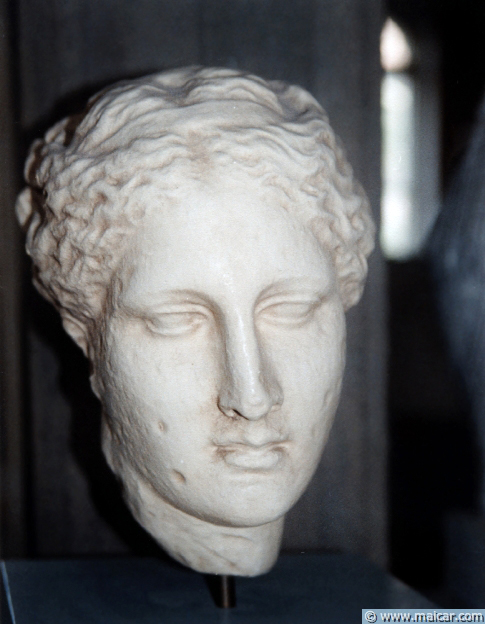
1322: Hygia. From the Temple of Athena Alea at Tegea, c. 360 BC. Antikmuseet, Lund.
|
|
|
"If a mortal has been granted health and can live off his own goods, he rivals the most fortunate. There is joy in all human life as long as it lacks disease and helpless deprivation." (Bacchylides, Odes 1.165).
"If a man cultivates both prosperity and health, being generous with his possessions and winning praise as well, let him not seek to become a god." (Pindar, Olympian Odes 5.23-24).
"… of all the three objects which concern every man, the concern for money, rightly directed, comes third and last; that for the body comes second; and that for the soul, first. Accordingly, if it prescribes its honors in this order, the policy which we are describing has its laws correctly laid down; but if any of the laws therein enacted shall evidently make health of more honor in the State than temperance, or wealth than health and temperance, it will quite clearly be a wrong enactment." (Plato, Laws 743d-744a).
"And when licentiousness and disease multiply in a city, are not many courts of law and dispensaries opened, and the arts of chicane and medicine give themselves airs when even free men in great numbers take them very seriously?. . .Will you be able to find a surer proof of an evil and shameful state of education in a city than the necessity of first-rate physicians and judges, not only for the base and mechanical, but for those who claim to have been bred in the fashion of free men? Do you not think it disgraceful and a notable mark of bad breeding to have to make use of a justice imported from others, who thus become your masters and judges, from lack of such qualities in yourself?" (Plato, Republic 405a-405b).
"… when he is sick (he). expects his physician to give him a drug which will operate as an emetic on the disease, or to get rid of it by purging or the use of cautery or the knife. But if anyone prescribes for him a long course of treatment with swathings about the head and their accompaniments, he hastily says that he has no leisure to be sick and that such a life of preoccupation with his illess and neglect of the work that lies before him isn't worth living. And thereupon he bids farewell to that kind of physician, enters upon his customary way of life, regains his health, and lives attending to his affairs—or, if his body is not equal to strain, he dies and is freed from all his troubles." (Plato, Republic 406d-406e).
|
|
Hygia is Health, the divinity whose force
fosters agreement among contrary qualities inside
the body where it ought to flourish, and removes it
from where it should not be. She is currently
known, not as a deity or intelligent force, but as
a passive bodily condition (to be acted upon or be
left alone) opposite to that caused by disease;
this condition, though regarded as a purely
physical phenomenon, is nevertheless revered as a
deity: "A people gets the
gods which it deserves." (Cecil M. Bowra).
From Zeus to Hygia
Hygia is the daughter of Asclepius, the god
that attends the ailments of each man or woman.
Both are very important regarding health, yet the
god of healing remains Apollo, who is Asclepius' father and
represents purity itself. For sickness (it has been
conjectured) is a form of pollution, whose secret
paths must first be discovered through the obscure
words of the god of oracles, son of Zeus:
"Loxias (Apollo, the Oblique) is the spokesman of Zeus, his father." (The Pythian priestess. Aeschylus. Eumenides 19).
Higher gods
Thus there are four generations between the
ruler of Heaven and the health of mortals,
who—to begin (or end) with—must remain
the prey of unhealthy Death. This annoying
circumstance is ordained by the MOERAE, and Zeus will not allow anything else; otherwise he had saved his own son Sarpedon 1, whom he loved, and he had abstained from smiting Asclepius with his thunderbolt when the latter started to
raise the dead. This happened because men are not
like the gods; and consequently Zeus also punished Prometheus 1 when he stole the divine fire and gave it to men, who in turn—following their own wisdom—employed it to cook and boil each other. Accordingly, the counsel of Apollo, "know thyself", has been taken as a reminder meaning "know that you are not a god", since the heart of man tends to forget that circumstance. And although all health comes from this god—called "the bright one"—it is also well documented that Apollo may descend from heaven "darker than night", letting fall upon men all kind of pestilences. Something similar could be said of his sweet sister Artemis, who is a giver
of life and a deliverer, but also a slayer.
Closer to humans
These great gods are far away, and usually keep
their distance:
"Shaker of
Earth, as no wise sound of mind would you count me,
if I fought you for the sake of mortals, pitiful
creatures, that like unto leaves are now full of
flaming life, eating the fruit of the field, and
now again pine away and perish." (Apollo to Poseidon. Homer, Iliad 21.462).
Knowing or sensing this, humans invoke other
gods, who, like Asclepius or Hygia,
seem to dwell closer to them. This they do even
when they are healthy, for sickness is an
omnipresent threat:
"Truly
blooming health does not rest content within its
due bounds; for disease ever presses close against
it, its neighbor with a common wall." (The Argive Elders. Aeschylus, Agamemnon 1001).
And even though they might not call them "gods", they will not cease to invoke them and desire what they represent, since no other circumstance can be sensed as so oppressive than to be afflicted with illness, which casts, before the eyes of the diseased, a dark shadow over the whole world and deprives life of its joy.
Desire of health
Therefore, of the goods that are bestowed on
humans, health is said to rank first (before
beauty, strength, and wealth). The health of humans
has been said to come from Nature, or Fortune, or Zeus, or from Asclepius and his daughter Hygia, or from any other deity. Others say or imply that gods do not decide on these matters, probably because they do not exist; it is asserted instead that health derives from a number of "random circumstances", but these are often revered as gods anyway. In any case (for there is no need to go on
bothering oneself with the question of who
administers the world), man, some think, can do
nothing or very little about his own health:
whether he will be born strong or weak, whole or
lame, will look at the light or else be blind, and
whether he will remain in one way or another
throughout his life. Accordingly, their advice is
not to set one's desire on health:
"… nor on anything else which is not your own. For that which is not in your power to acquire or to keep is none of yours. Keep far away from it not merely your hands, but above all your desire; otherwise, you have delivered yourself into slavery …" (Epictetus, 4.1.76).
But many others believe that humans and their
behavior do exert an influence on their health:
"Men say that
a way of life too unswerving leads more to a fall
than to satisfaction and is more hurtful to health.
That is why I have much less praise for excess than
for moderation." (Nurse to Phaedra. Euripides, Hippolytus 261).
… and that both patient and physician may come to terms with health or else spoil it, depending on how they act:
"Ought not the
doctor that is giving counsel to a sick man who is
indulging in a mode of life that is bad for his
health to try first of all to change his life, and
only proceed with the rest of his advice if the
patient is willing to obey?" (Plato, Letters 330c-330d).
|
|
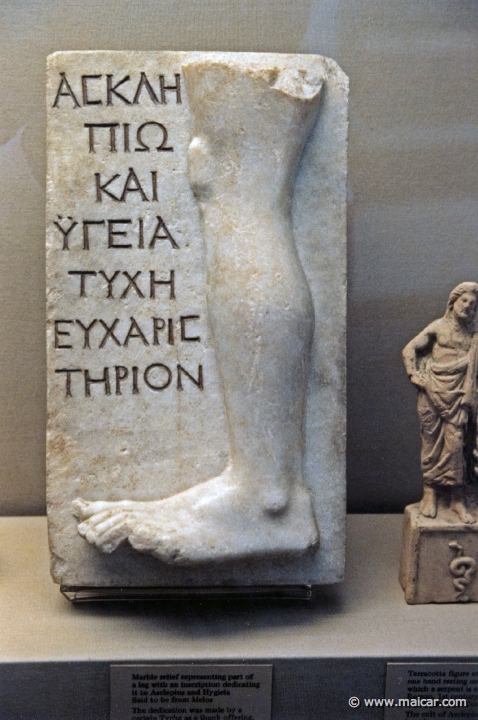
8310: Thank offering for a cure of some affliction of the left leg. The inscription reads: "Tyche thanks Asclepius and Hygia." Marble relief, Melos. British Museum, London.
|
|
Body and Soul
At the same time, Health has not been divorced
from Justice; for the
balance that Health gives the body resembles that
which Justice gives the
soul. And since an agreement between body and soul
has always been aimed at, physicians have been
graded accordingly, for they
"… treat the body with the mind—and it is not competent for a mind that is or has been evil to treat anything well." (Plato, Republic 408e).
Thus Health has also been regarded as part of a
greater whole, being ruled by the same laws that
keep harmony, both in heaven and on earth.
Accordingly, the counsel of Apollo at Delphi, "Nothing in excess", is believed to help the preservation of balance and harmony in all matters, including health. By bringing the same kind of consonance and
agreement among the sounds, the harmony of music is
created, just like the balance between the fast and
the slow appropriately combined produces its
rhythm. And as in music, so in medicine: these
agreements and consonances are the works of Love, being ruled by Apollo, and administered
by his son Asclepius and the latter's daughter Hygia. Health may be pictured as "happiness of the body", and happiness could be pictured as "health of the mind". Further, bodily health may be thought to help the happiness of the mind; and conversely, happiness may be imagined to promote health. But bodily health has been regarded as a lesser
good, coming after the goods that are divine, such
as wisdom, rational moderation, justice, and
courage; for a worthless life has been regarded as
even worse, when the body is healthy:
"To be healthy
for a good end is good, to be healthy for an evil
end is evil." (Epictetus, 3.20.4).
Thus it has been argued that a healthy and
wealthy man, who even enjoys strength and courage,
will nevertheless lead a wretched life if he has
within himself nothing but injustice and insolence.
Therefore, the health of the soul has been declared
to come first, and the health of the body second:
"… if any of the laws therein enacted shall evidently make health of more honor in the State than temperance, or wealth than health and temperance, it will quite clearly be a wrong enactment." (Plato, Laws 743d-744a).
For neither one man nor a whole community could ever be happy if they indulged in injustice. And if they were unhappy, then health would be helping to perpetuate their misery. Therefore it is better for a wretched life to promptly come to an end than to continue, though in health, on an evil course. Hygia—they appear to suggest—lives together with her father and grandfather, and all act by the same laws. Also body and soul live together, the former for the sake of the latter. "Health is great, but happiness is even greater," they seem to say. For beauty and meaning may still visit the patient. But to the house of the evil man, come only ugliness and Necessity, and others like them; and the healthier he is, the more visits he receives, permanently wasting his strength in annoying matters. It is also in such ways that Hygia rejoins the
other gods, who, although being many, are perfectly
acquainted with each other.
|

